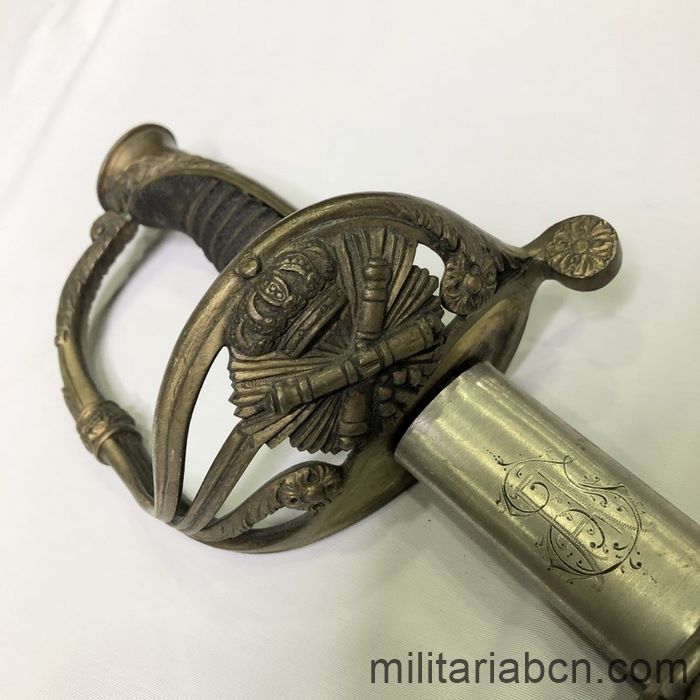
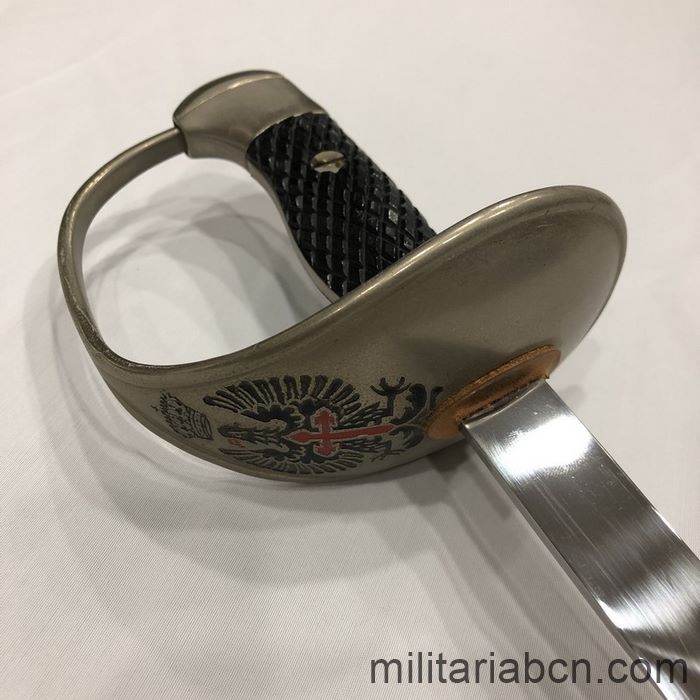
Spain. Bourbon Monarchy. Enlisted Men’s Cavalry Sword of the Royal Corps of Bodyguards. Horse-Mouth Hilt. 18th – Early 19th Century (1704–1814).
Cavalry sword attributed to the enlisted personnel of the Royal Corps of Bodyguards (Real Cuerpo de Guardias de Corps), a mounted unit of the Spanish Royal Household established in 1704 during the reign of Philip V. It features a distinctive iron hilt of the type known as “boca de caballo” (horse-mouth), a straight double-edged blade and inscriptions referring to the corps. Its characteristics place it within the tradition of cavalry swords used by this unit during the 18th and early 19th centuries.
The Royal Corps of Bodyguards was established by Philip V in 1704, following the model of the mounted guards of the French royal court. Its principal duties included protecting and escorting the monarch and royal family, together with ceremonial and representational functions. Its members belonged to a prestigious formation within the military organization of the Spanish monarchy.
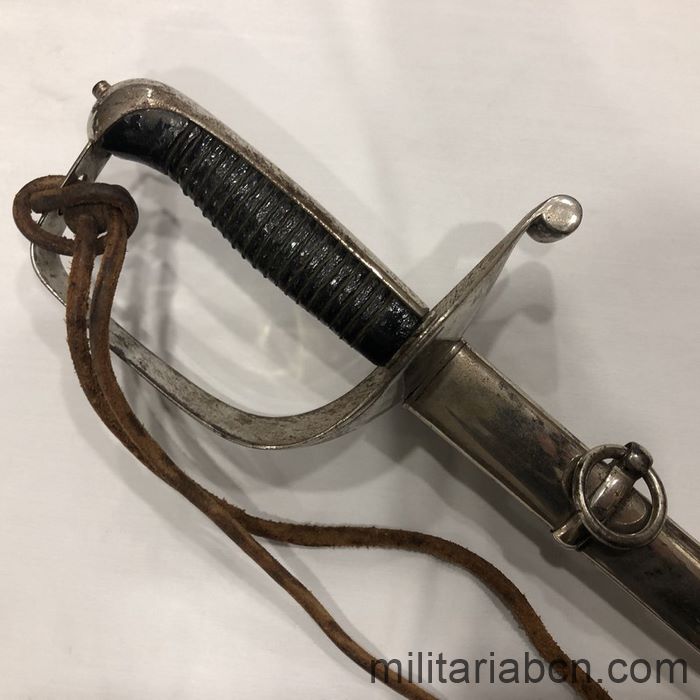
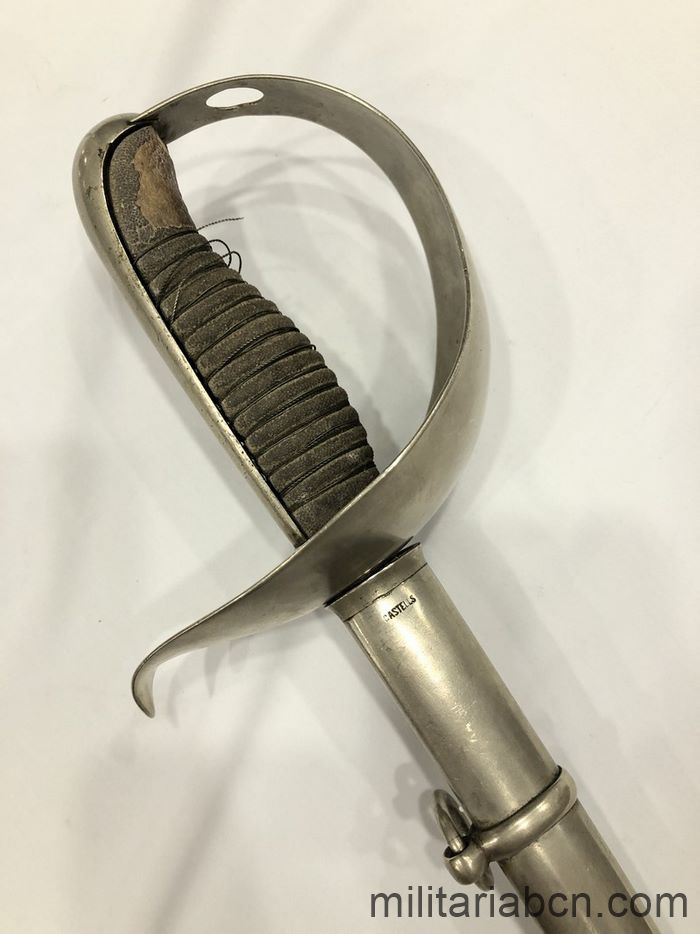
The hilt is constructed entirely of worked iron, with carefully executed details despite being intended for enlisted personnel. It belongs to the type traditionally known as “boca de caballo”, a Spanish designation applied to certain cavalry sword hilts characterized by their protective shells and distinctive arrangement of components.
The guard incorporates two asymmetrical shells, secured by four screws positioned close to the blade’s ricasso. Small decorative escutcheons are present above the ricasso, forming part of the guard’s ornamentation.
The knuckle bow has a strongly pronounced curve, giving the hilt its distinctive profile. The crossguard incorporates two quillons curving in opposite directions, providing additional protection for the hand.
The pommel is spherical and flattened at its poles, with diamond-shaped facets arranged around its equatorial circumference. It is surmounted by a decorative finial and rests upon two opposed truncated-conical bases, a particularly distinctive feature of the hilt.
The grip is spindle-shaped and made of wood, widening towards the centre and narrowing at both ends.
The blade is straight and double-edged, with a ricasso at its base and a three-faceted geometry extending to the point. Its configuration is consistent with a cavalry sword intended for mounted service.
One side of the blade bears the inscription “RS. GS. D CORPS”, an abbreviation referring to the Reales Guardias de Corps (Royal Bodyguards), linking the weapon to this unit of the Spanish Royal Household.
The opposite side retains a second inscription, “RL FA Ð Tº”, which is difficult to decipher due to its condition. The transcription follows the visible characters, without assigning a definitive interpretation to the inscription.
Dimensions:
- Overall length: 103.5 cm.
- Blade length: 85 cm.
The cavalry swords of the Royal Bodyguards formed part of the equipment of a mounted formation directly responsible for the sovereign’s protection. Their design combined a straight double-edged blade with a substantial iron hilt intended to protect the hand during mounted service.
The horse-mouth hilt represents a characteristic form of iron guard found on certain Spanish military swords of the 18th century. Its asymmetrical shells, curved knuckle bow and opposing quillons distinguish it from other contemporary cavalry sword patterns.
The inscription referring to the Royal Bodyguards provides an important identifying feature supporting the sword’s attribution to this corps.
Enlisted men’s cavalry sword of the Royal Corps of Bodyguards, Spanish Bourbon monarchy, 18th – early 19th century. Iron “boca de caballo” (horse-mouth) hilt with two asymmetrical shells secured by four screws, strongly curved knuckle bow, opposing quillons and spherical pommel with diamond-shaped facets. Spindle-shaped wooden grip. Straight double-edged, three-faceted blade bearing the inscription “RS. GS. D CORPS” and a second partially legible inscription “RL FA Ð Tº”. Overall length 103.5 cm; blade length 85 cm. Attributed to the enlisted personnel of the Spanish Royal Bodyguards (1704–1814).