Usamos cookies en nuestro sitio web para darle la mejor experiencia. Al aceptar, aceptas el uso de todas las cookies. Puedes modificar o rechazar el uso de las cookies. Puedes ver la cookie policy.
Usamos cookies en nuestro sitio web para darle la mejor experiencia. Al aceptar, aceptas el uso de todas las cookies. Puedes modificar o rechazar el uso de las cookies. Puedes ver la cookie policy.




29 de mayo de 2026
In this article, we will analyze the WW2 Soviet Campaign Medals awarded for the defense of cities or sites in the Soviet Union during World War II. We will also show the different variations based on the rings used to determine when they were manufactured.
If you are interested in purchasing an original Soviet medal, you can visit our website:
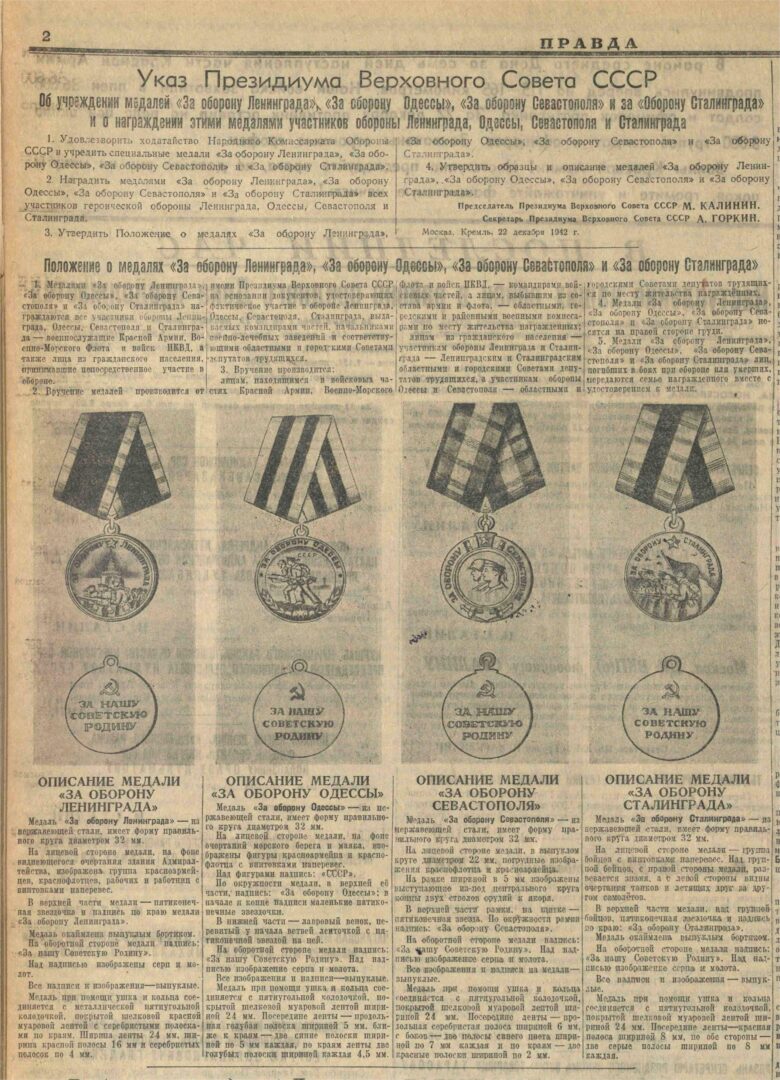
The December 24, 1942 edition of the newspaper Pravda features an editorial by Joseph Stalin outlining the motivations behind the creation of the first Soviet medals for the defense of cities and localities. Stalin’s words, delivered in an order issued on the occasion of the 25th anniversary of the Great October Socialist Revolution, established the ideological foundation of these medals: “The heroic defenders of Moscow and Tula, Odessa and Sevastopol, Leningrad and Stalingrad demonstrated examples of selfless courage, iron discipline, steadfastness, and the will to victory. Our entire Red Army follows the example of these heroes.”
From that point onward, a total of eight Defense campaign medals, four Capture campaign medals, and three Liberation campaign medals would be established to reward Soviet combatants who took part in the various campaigns of the Great Patriotic War, the term used by the Soviets to refer to World War II.
In this article, we will examine the Defense medals that form part of the Campaign Medals of the Soviet Union.
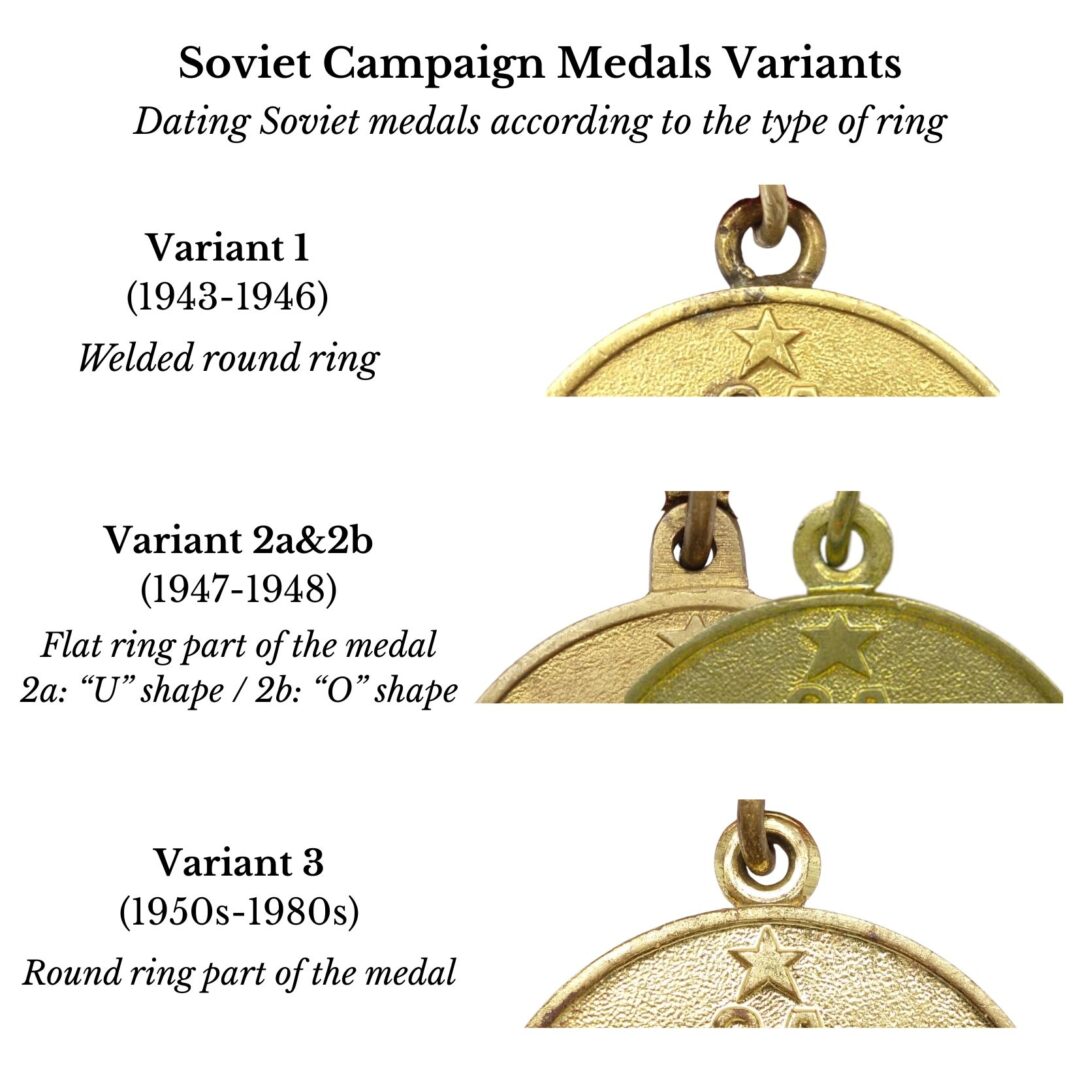
The Campaign Medals of the World War II can be distinguished by differences related to their production period. These differences are most clearly visible in the upper suspension ring, and for this reason collectors have identified three variants based on the type of ring in order to determine the approximate date of manufacture.
Variant 1 medals feature a round brass ring welded onto the medal. These were the first to be produced, between 1943 and 1946, and can easily be identified by the visible traces of soldering.
Variant 2 was manufactured in the years immediately following the end of the war, between 1947 and 1948. The ring could be either “U”-shaped or “O”-shaped, was flat, and formed an integral part of the medal itself.
Variant 3 medals, featuring a round ring integrated into the medal and made from a brighter material, were awarded by the Military Commissariat, or Voenkomat, years after the end of World War II. They were usually awarded to individuals who had participated in the battles but who, for one reason or another, had initially been overlooked by the authorities.
For collectors, both Variant 1 and Variant 2 are considered original World War II medals, since many of them were awarded during the years immediately after the war. Variant 3, however, began to be manufactured from the 1950s onward and is therefore considered postwar; as a result, its value is generally lower than that of the first two variants.
Below, we will examine each of the Defense Campaign Medals awarded for the defense of cities and localities.
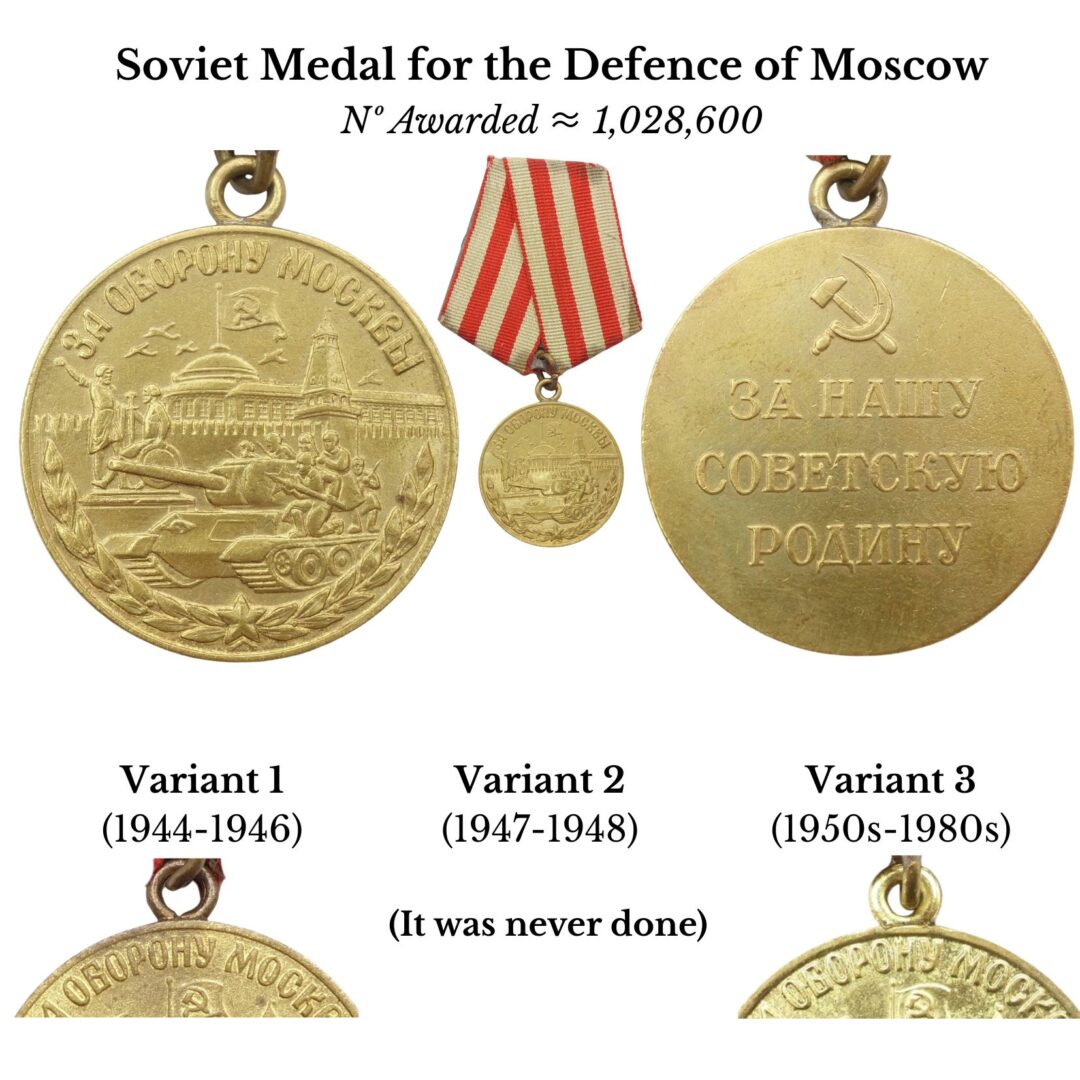
The Medal “For the Defence of Moscow” (Russian: Медаль «За оборону Москвы») was established on May 1, 1944, by decree of the Presidium of the Supreme Soviet of the Soviet Union.
The medal was awarded to all participants in the defense of Moscow: military personnel of the Red Army, the Navy, and NKVD troops, as well as civilians who directly participated in the construction of fortifications and in the defense of the capital.
The period considered as the Defense of Moscow extends from October 19, 1941, to January 25, 1942.
On July 20, 1944, the first “For the Defence of Moscow” medal was presented to Joseph Stalin. Along with the medal, he received certificate No. 000001.
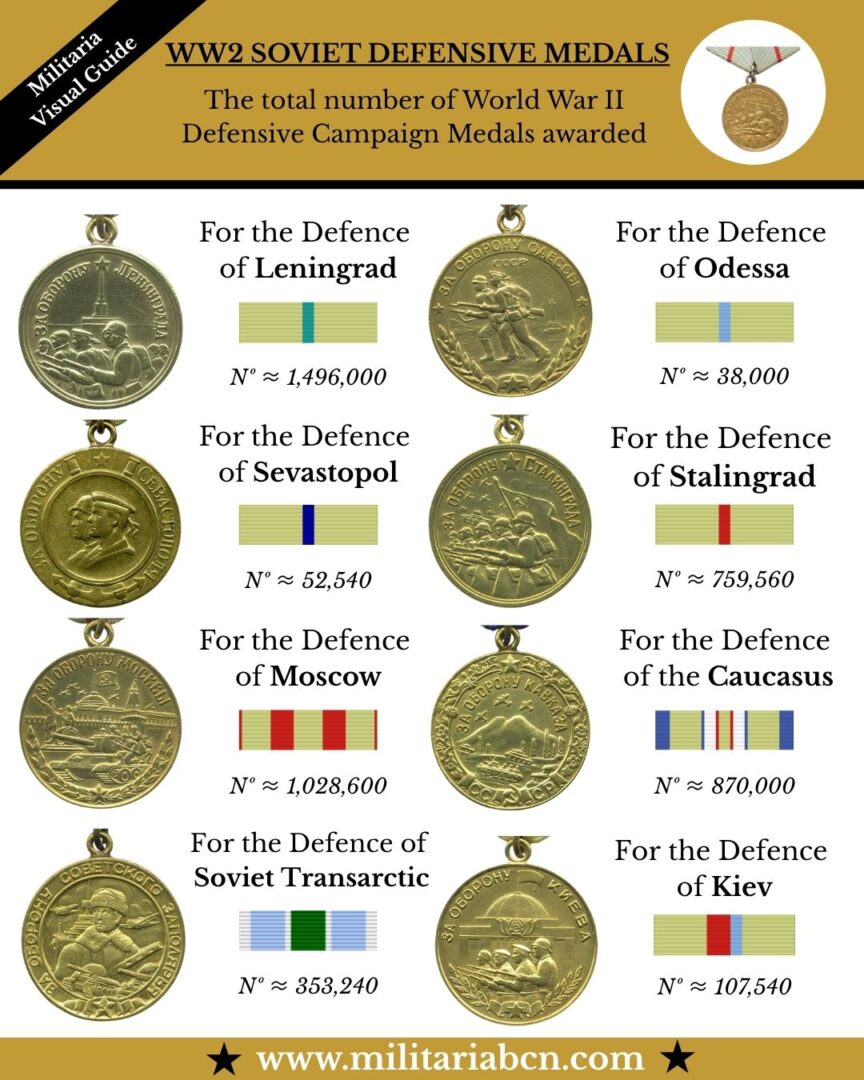
Approximately 1,028,600 medals were awarded.
The medal is circular, made of brass, and measures 32 mm in diameter.
On the obverse are depicted the Kremlin walls, a Soviet tank, and advancing soldiers. At the top appears the raised inscription “FOR THE DEFENCE OF MOSCOW” (Russian: «ЗА ОБОРОНУ МОСКВЫ»).
On the reverse, there is a hammer and sickle at the top, with the inscription “FOR OUR SOVIET MOTHERLAND” (Russian: «ЗА НАШУ СОВЕТСКУЮ РОДИНУ») beneath it.
The medal is suspended from an olive-colored pentagonal ribbon with red stripes.
Only Variant 1 and Variant 3 exist for the Medal “For the Defence of Moscow”; no medals were manufactured with the Variant 2 suspension ring.
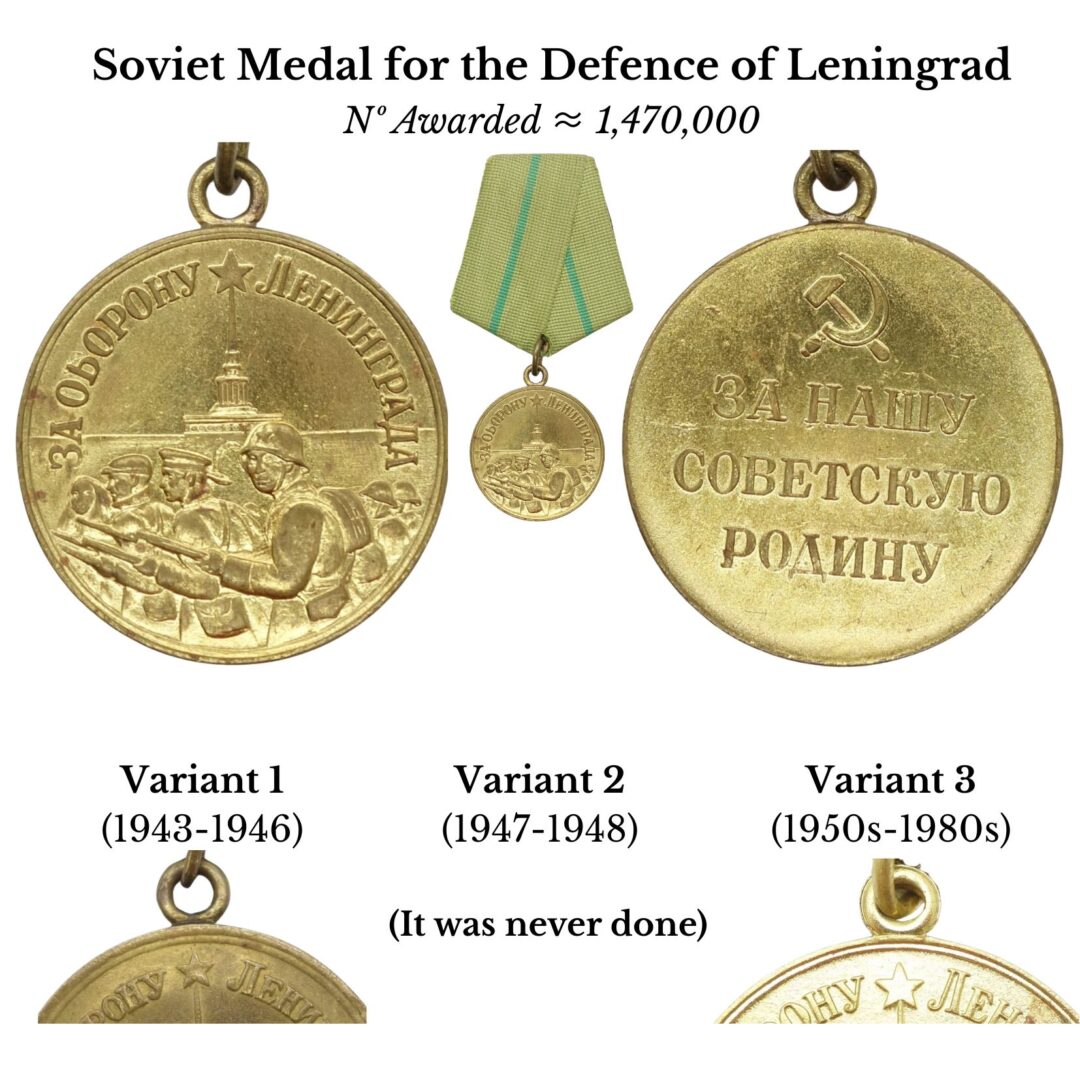
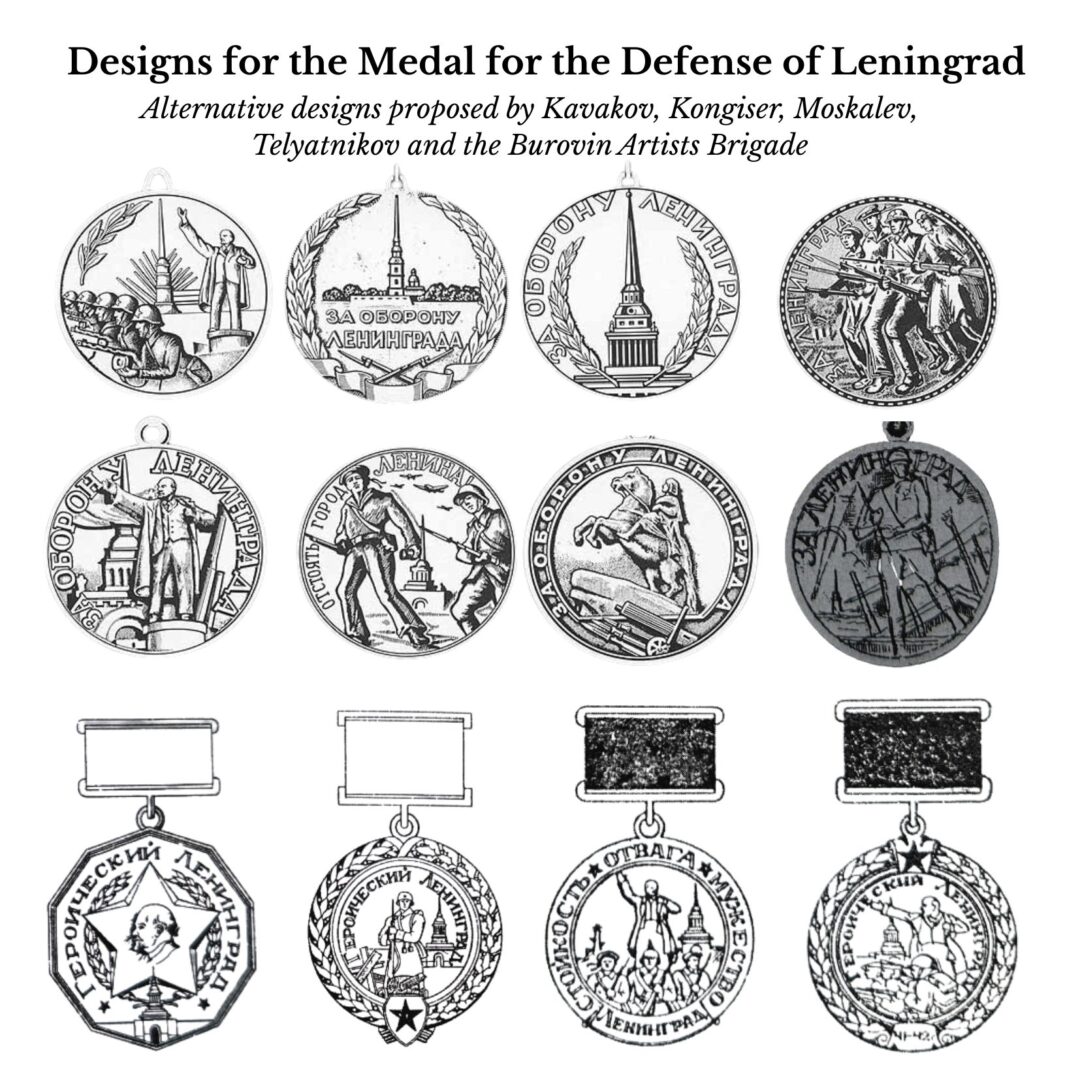
The Medal “For the Defence of Leningrad” (Russian: Медаль «За оборону Ленинграда») was established on December 22, 1942, by decree of the Presidium of the Supreme Soviet of the Soviet Union.
The medal was awarded to military personnel of the Red Army, the Navy, and NKVD troops, as well as to civilians who directly participated in the defense of the city of Leningrad.
The period considered as the Defense of Leningrad extends from July 10, 1941, to January 27, 1944.
Approximately 1,470,000 medals were awarded.
The medal is circular, made of brass, and measures 32 mm in diameter.
The obverse depicts armed Soviet soldiers in front of the Admiralty building in Leningrad. At the top appears the inscription “FOR THE DEFENCE OF LENINGRAD” (Russian: «ЗА ОБОРОНУ ЛЕНИНГРАДА»).
On the reverse, a hammer and sickle appear above the inscription “FOR OUR SOVIET MOTHERLAND.”
The medal is suspended from an olive-colored pentagonal ribbon with a central green stripe.
Only Variant 1 and Variant 3 exist for the Medal “For the Defence of Leningrad”; no medals were manufactured with the Variant 2 suspension ring.
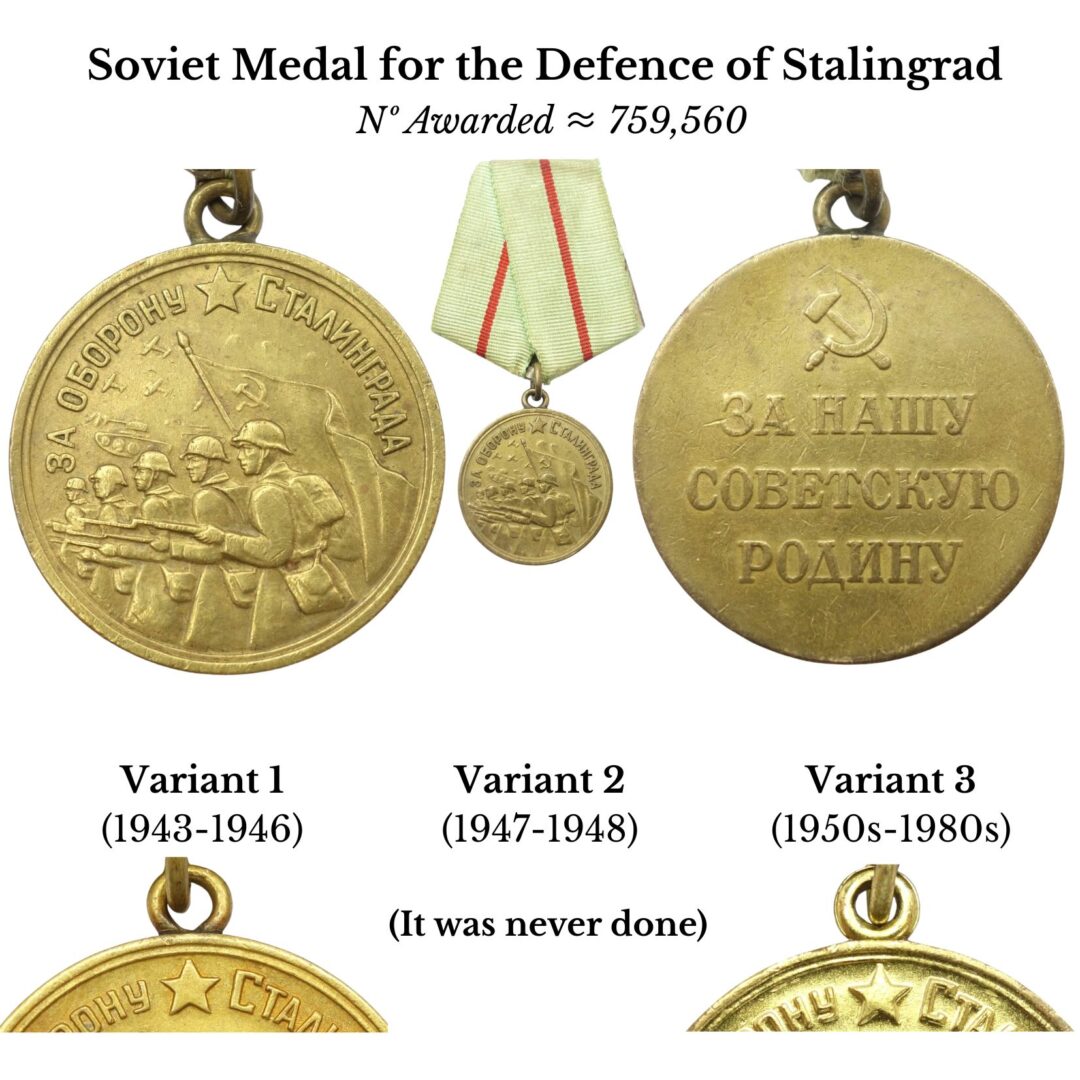
The Medal “For the Defence of Stalingrad” (Russian: Медаль «За оборону Сталинграда») was established on December 22, 1942, by decree of the Presidium of the Supreme Soviet of the Soviet Union.
The medal was awarded to all participants in the Battle of Stalingrad: military personnel of the Red Army, the Navy, and NKVD troops, as well as civilians who directly participated in the defense.
The period considered as the Defense of Stalingrad extends from July 12 to November 19, 1942.
Approximately 759,560 medals were awarded.
The medal is circular, made of brass, and measures 32 mm in diameter.
On the obverse, soldiers are depicted in front of the Soviet flag, with tanks and aircraft in the background. At the top appears the raised inscription “FOR THE DEFENCE OF STALINGRAD” (Russian: «ЗА ОБОРОНУ СТАЛИНГРАДА»).
On the reverse, there is a hammer and sickle at the top, with the inscription “FOR OUR SOVIET MOTHERLAND” (Russian: «ЗА НАШУ СОВЕТСКУЮ РОДИНУ») beneath it.
The medal is suspended from an olive-green pentagonal ribbon with a red central stripe.
Only Variant 1 and Variant 3 exist for the Medal “For the Defence of Stalingrad”; no medals were manufactured with the Variant 2 suspension ring.
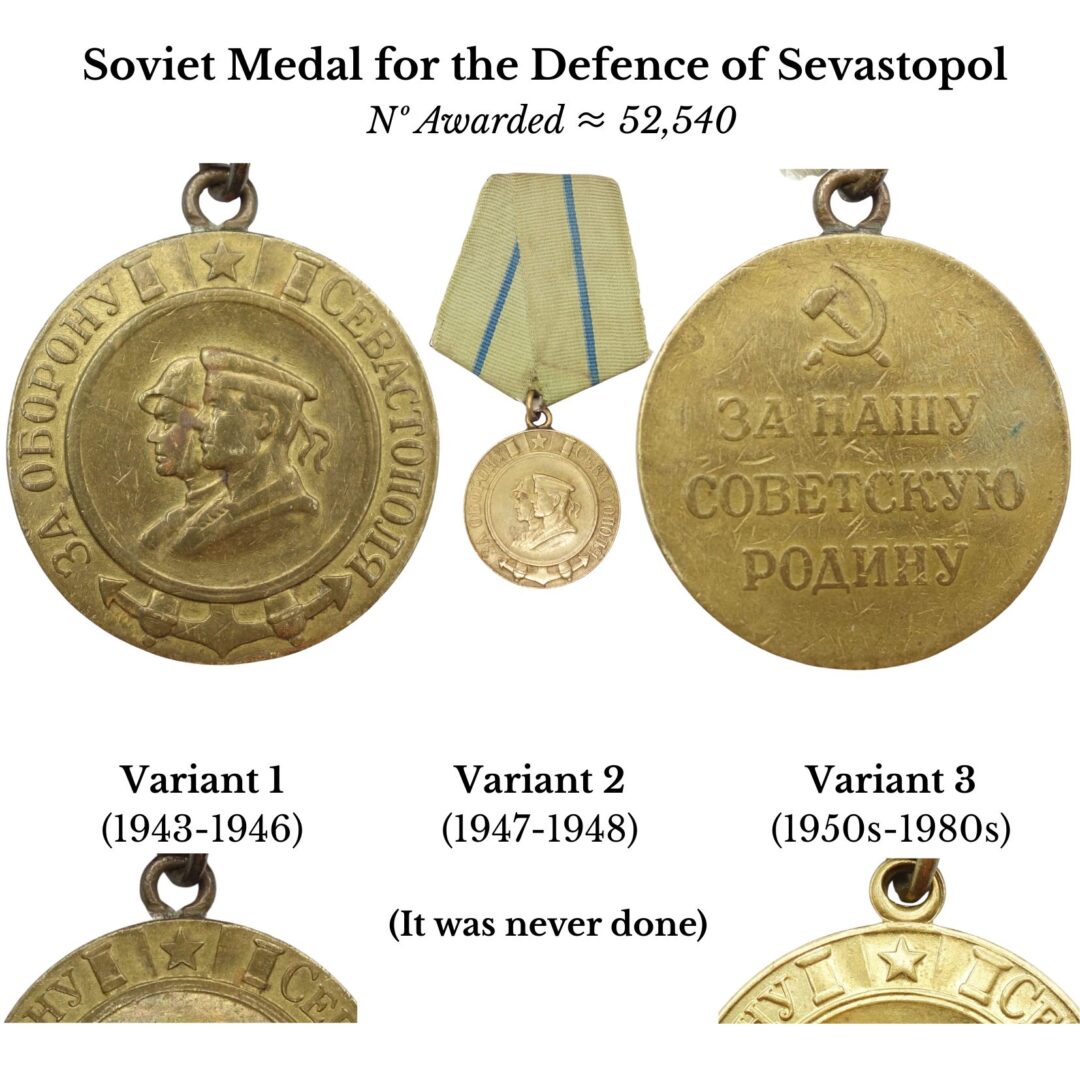
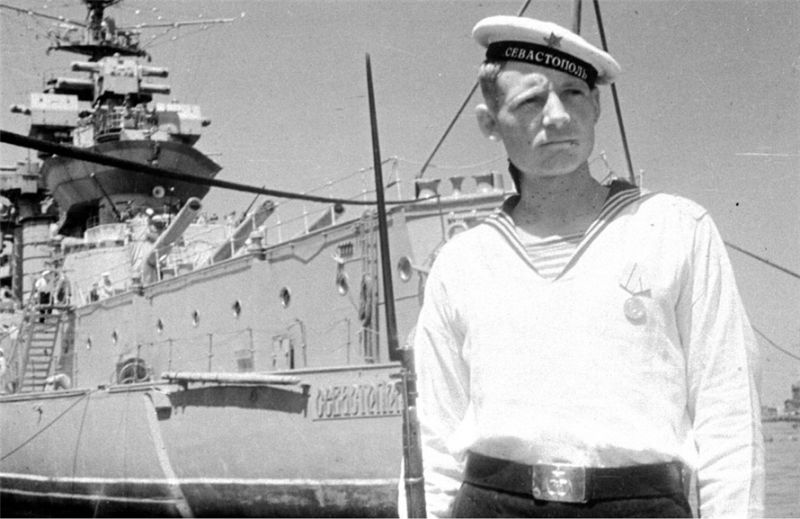
The Medal “For the Defence of Sevastopol” (Russian: Медаль «За оборону Севастополя») was established on December 22, 1942, by decree of the Presidium of the Supreme Soviet of the Soviet Union.
The medal was awarded to military personnel and civilians who participated in the defense of Sevastopol against German and Romanian forces.
The period considered as the Defense of Sevastopol extends from October 30, 1941, to July 4, 1942.
Approximately 52,540 medals were awarded.
The medal is circular, made of brass, and measures 32 mm in diameter.
The obverse depicts the busts of a Soviet sailor and soldier. At the top appears the inscription “FOR THE DEFENCE OF SEVASTOPOL” (Russian: «ЗА ОБОРОНУ СЕВАСТОПОЛЯ»).
On the reverse, there is a hammer and sickle together with the inscription “FOR OUR SOVIET MOTHERLAND.”
The medal is suspended from an olive-colored pentagonal ribbon with a central dark blue stripe.
Only Variant 1 and Variant 3 exist for the Medal “For the Defence of Sevastopol”; no medals were manufactured with the Variant 2 suspension ring.
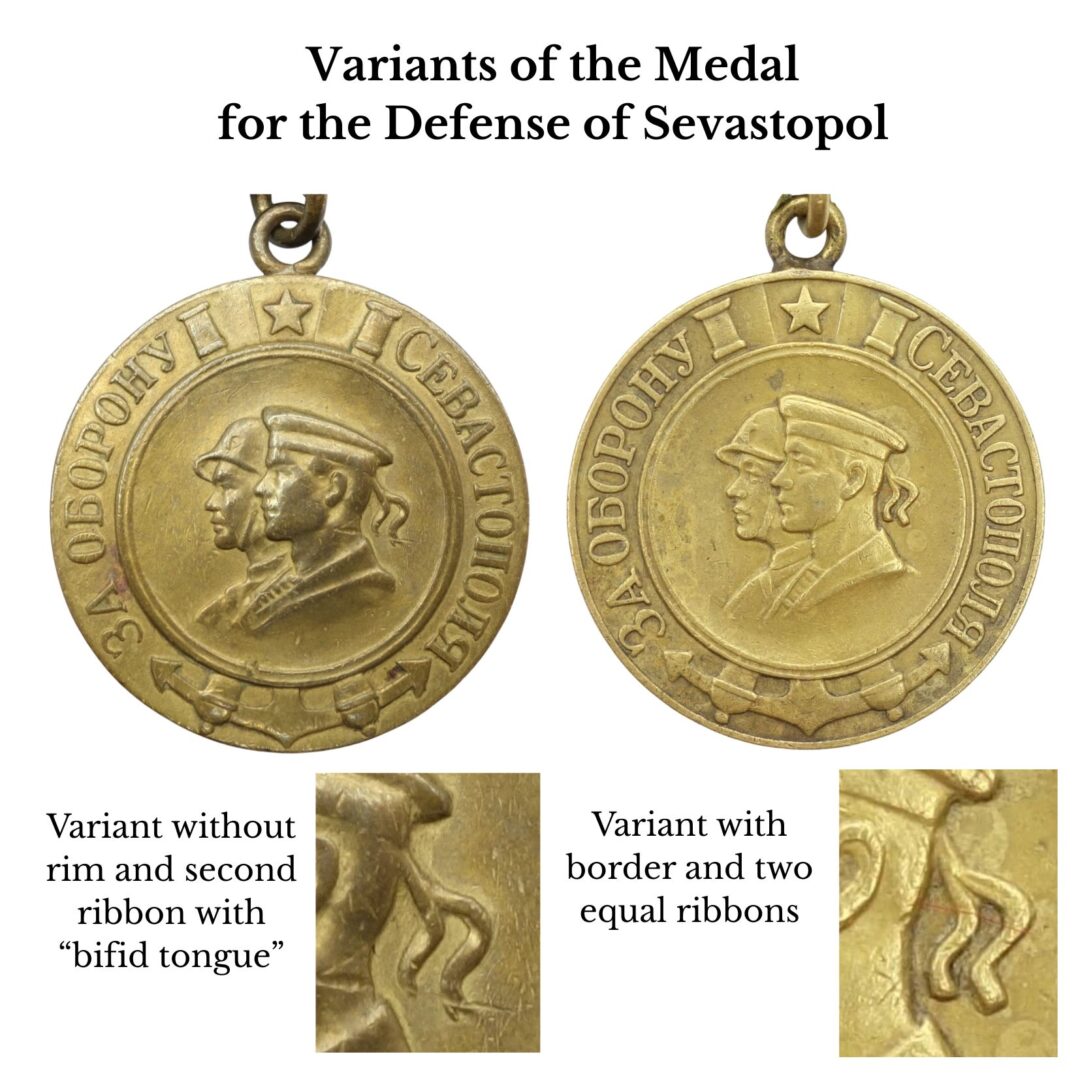
In addition, there are two different obverse designs. In the first type, the medal has no rim and the second ribbon of the sailor’s cap is split into two parts (resembling a snake’s forked tongue). In the second type, there is also no rim, but the sailor’s cap ribbons are identical and positioned closer together.
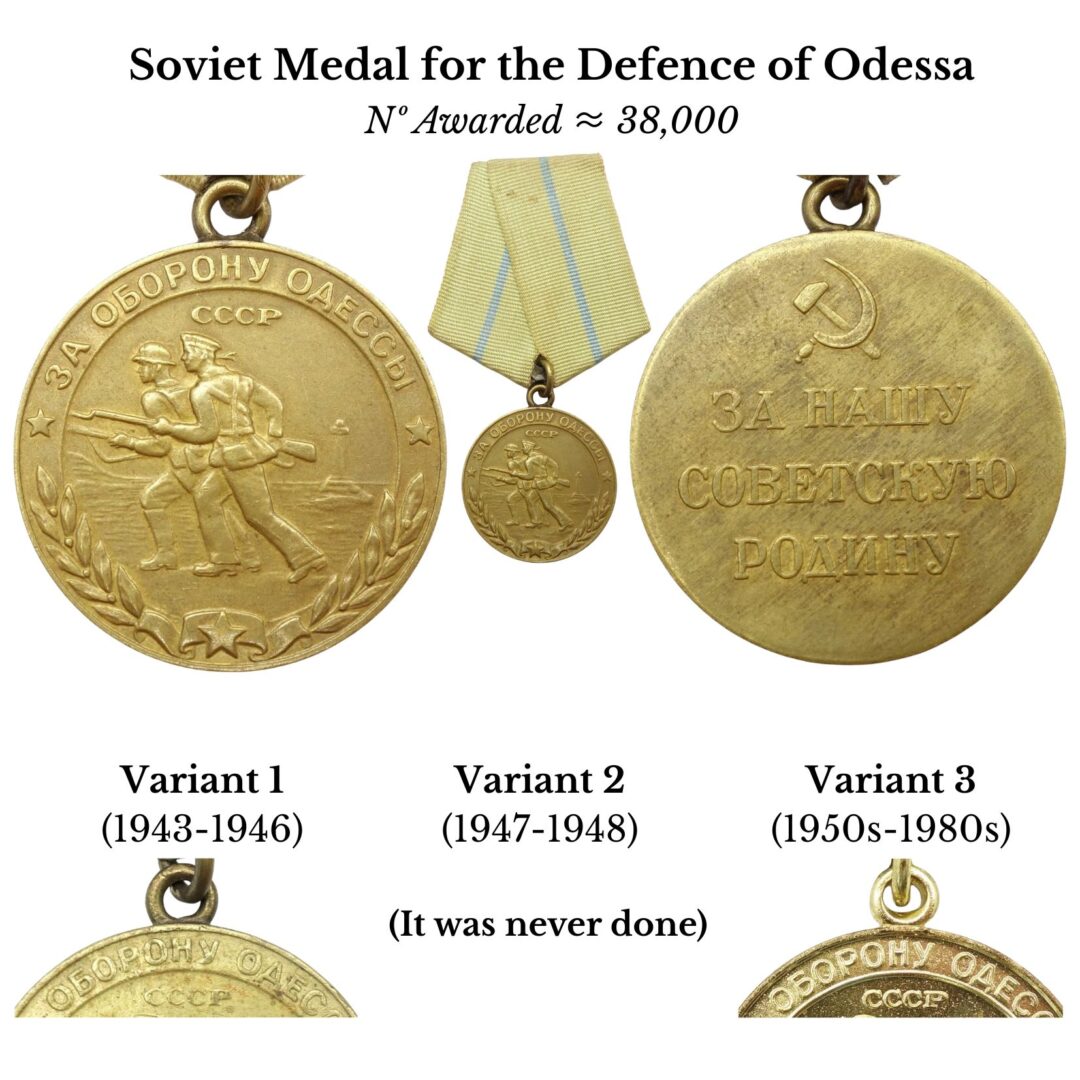
The Medal “For the Defence of Odessa” (Russian: Медаль «За оборону Одессы») was established on December 22, 1942, by decree of the Presidium of the Supreme Soviet of the Soviet Union.
The medal was awarded to military personnel and civilians who participated in the defense of Odessa.
The period considered as the Defense of Odessa extends from August 5 to October 16, 1941.
Approximately 38,000 medals were awarded.
The medal is circular, made of brass, and measures 32 mm in diameter. Initially, the medal was intended to be manufactured in stainless steel; however, by decree of March 27, 1943, brass was approved as the material for its production.
The obverse depicts an armed soldier and sailor standing before the sea and a lighthouse. At the top appears the inscription “FOR THE DEFENCE OF ODESSA” (Russian: «ЗА ОБОРОНУ ОДЕССЫ»).
On the reverse, there is a hammer and sickle above the inscription “FOR OUR SOVIET MOTHERLAND.”
The medal is suspended from an olive-colored pentagonal ribbon with a central light blue stripe.
Only Variant 1 and Variant 3 exist for the Medal “For the Defence of Odessa”; no medals were manufactured with the Variant 2 suspension ring.
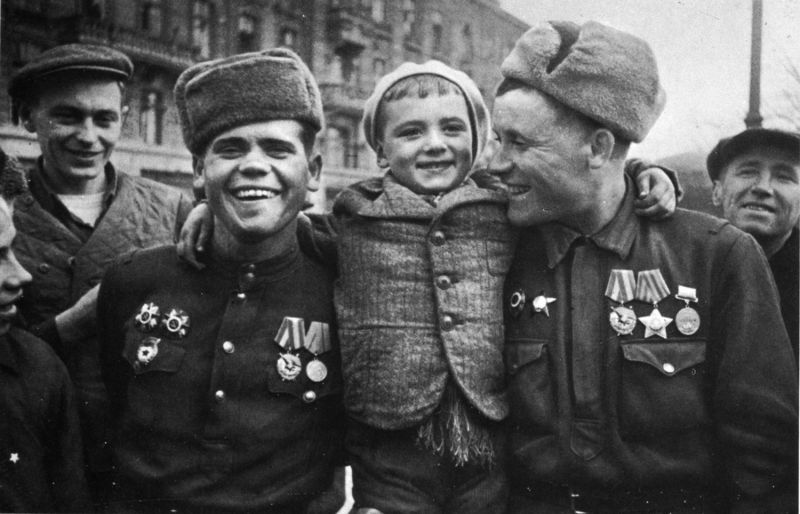
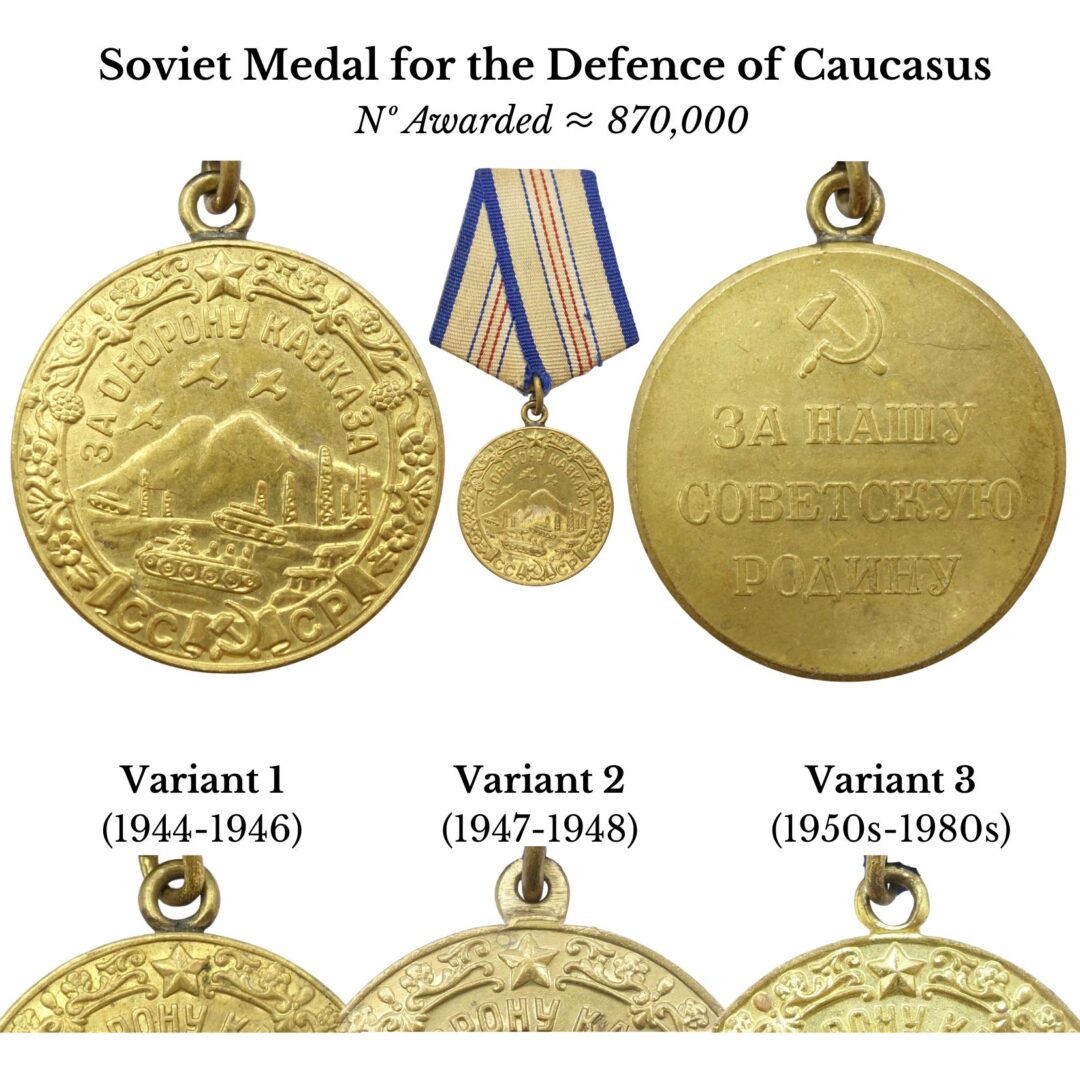
The Medal “For the Defence of the Caucasus” (Russian: Медаль «За оборону Кавказа») was established on May 1, 1944, by decree of the Presidium of the Supreme Soviet of the Soviet Union.
The medal was awarded to all participants in the defense of the Caucasus, including both military personnel and civilians.
The campaign period extends from July 1942 to October 1943.
Approximately 870,000 medals were awarded.
The medal is circular, made of brass, and measures 32 mm in diameter.
The obverse depicts Mount Elbrus together with tanks, aircraft, and oil derricks. At the top appears the inscription “FOR THE DEFENCE OF THE CAUCASUS” (Russian: «ЗА ОБОРОНУ КАВКАЗА»).
On the reverse appear the hammer and sickle together with the inscription “FOR OUR SOVIET MOTHERLAND.”
The medal is suspended from an olive-colored pentagonal ribbon with blue edges, two white stripes, and red lines.
Variant 1, Variant 2, and Variant 3 all exist for the Medal “For the Defence of the Caucasus.”
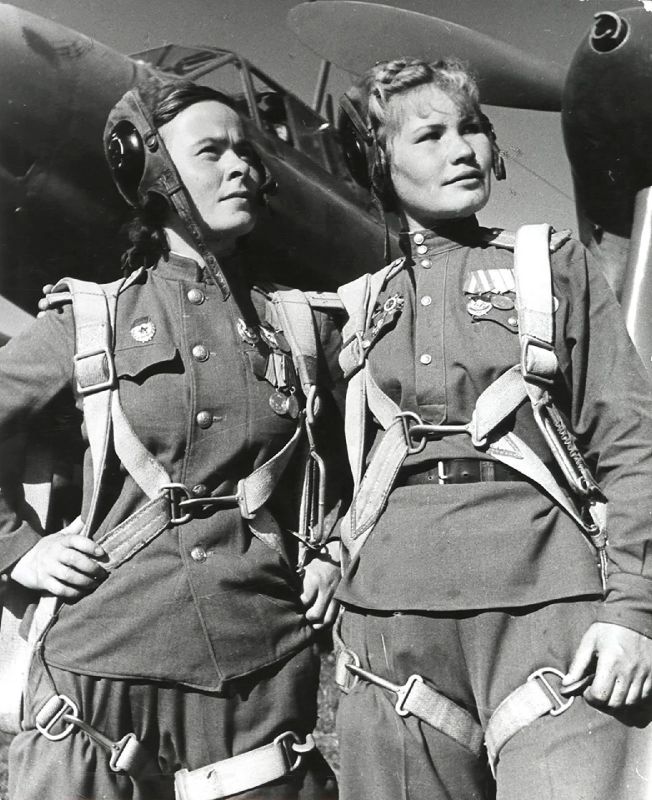
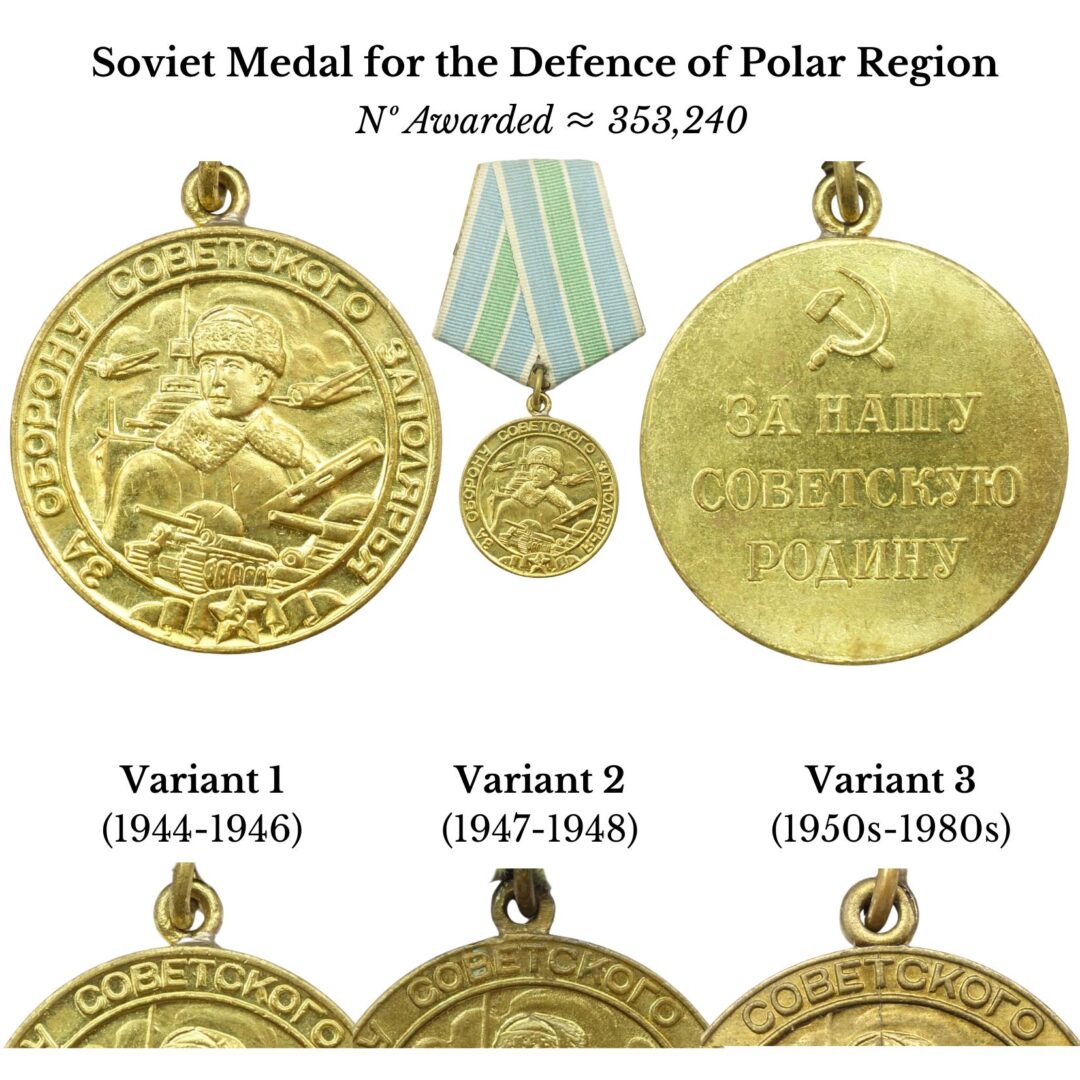
The Medal “For the Defence of the Soviet Arctic” (Russian: Медаль «За оборону Советского Заполярья») also known as «Polar Region», was established on December 5, 1944, by decree of the Presidium of the Supreme Soviet of the Soviet Union.
The medal was awarded to military personnel and civilians who participated in the defense of the Soviet Arctic region.
The period considered as the defense campaign extends from June 22, 1941, to November 1944.
Approximately 353,240 medals were awarded.
The medal is circular, made of brass, and measures 32 mm in diameter.
The obverse depicts a Soviet soldier wearing a winter coat and carrying a submachine gun, alongside ships and aircraft. At the top appears the inscription “FOR THE DEFENCE OF THE SOVIET ARCTIC” (Russian: «ЗА ОБОРОНУ СОВЕТСКОГО ЗАПОЛЯРЬЯ»).
On the reverse appear the hammer and sickle above the inscription “FOR OUR SOVIET MOTHERLAND.”
The medal is suspended from a blue pentagonal ribbon with a central green stripe.
Variant 1, Variant 2, and Variant 3 all exist for the Medal “For the Defence of the Soviet Arctic.”
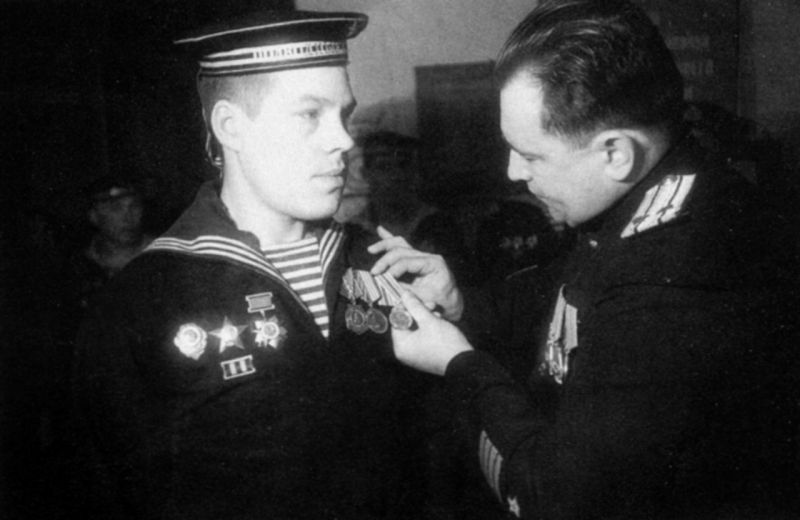
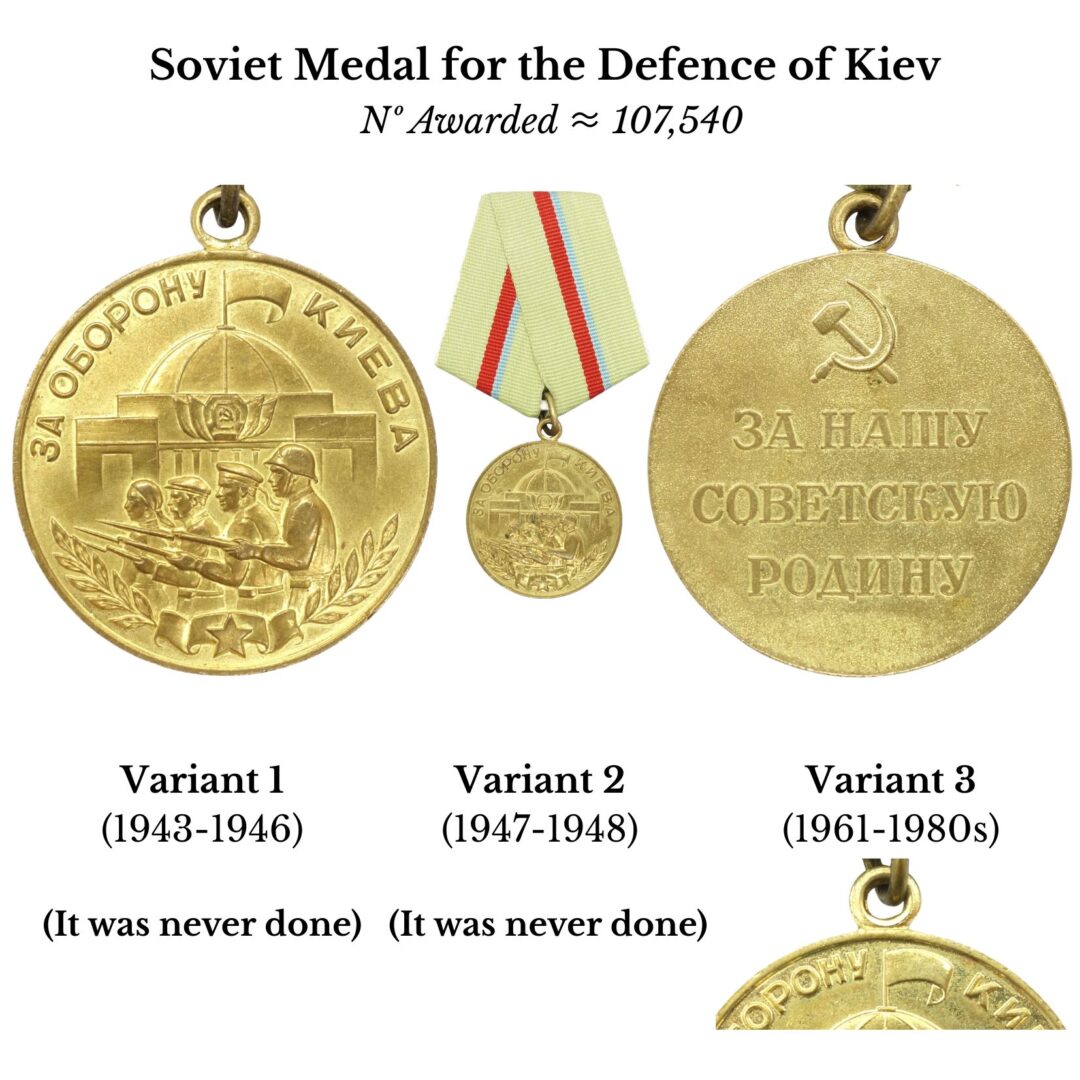
Although Kiev was the scene of major fighting in 1941 and 1943, the Medal “For the Defence of Kiev” was not established during World War II because Joseph Stalin refused to approve it. It was created later, on June 21, 1961, when Nikita Khrushchev revived the proposal in order to recognize those who had participated in the defense of the city.
The medal was awarded to military personnel and civilians who participated in the defense of Kiev between July and September 1941.
Approximately 107,540 medals were awarded.
The medal is circular, made of brass, and measures 32 mm in diameter.
The obverse depicts soldiers, sailors, workers, and civilians in front of the building of the Supreme Soviet of the Ukrainian SSR. At the top appears the inscription “FOR THE DEFENCE OF KIEV” (Russian: «ЗА ОБОРОНУ КИЕВА»).
On the reverse appears the standard inscription “FOR OUR SOVIET MOTHERLAND.”
The medal is suspended from an olive-green pentagonal ribbon with one red stripe and one blue stripe.
Only Variant 3 exists for the Medal “For the Defence of Kiev.”
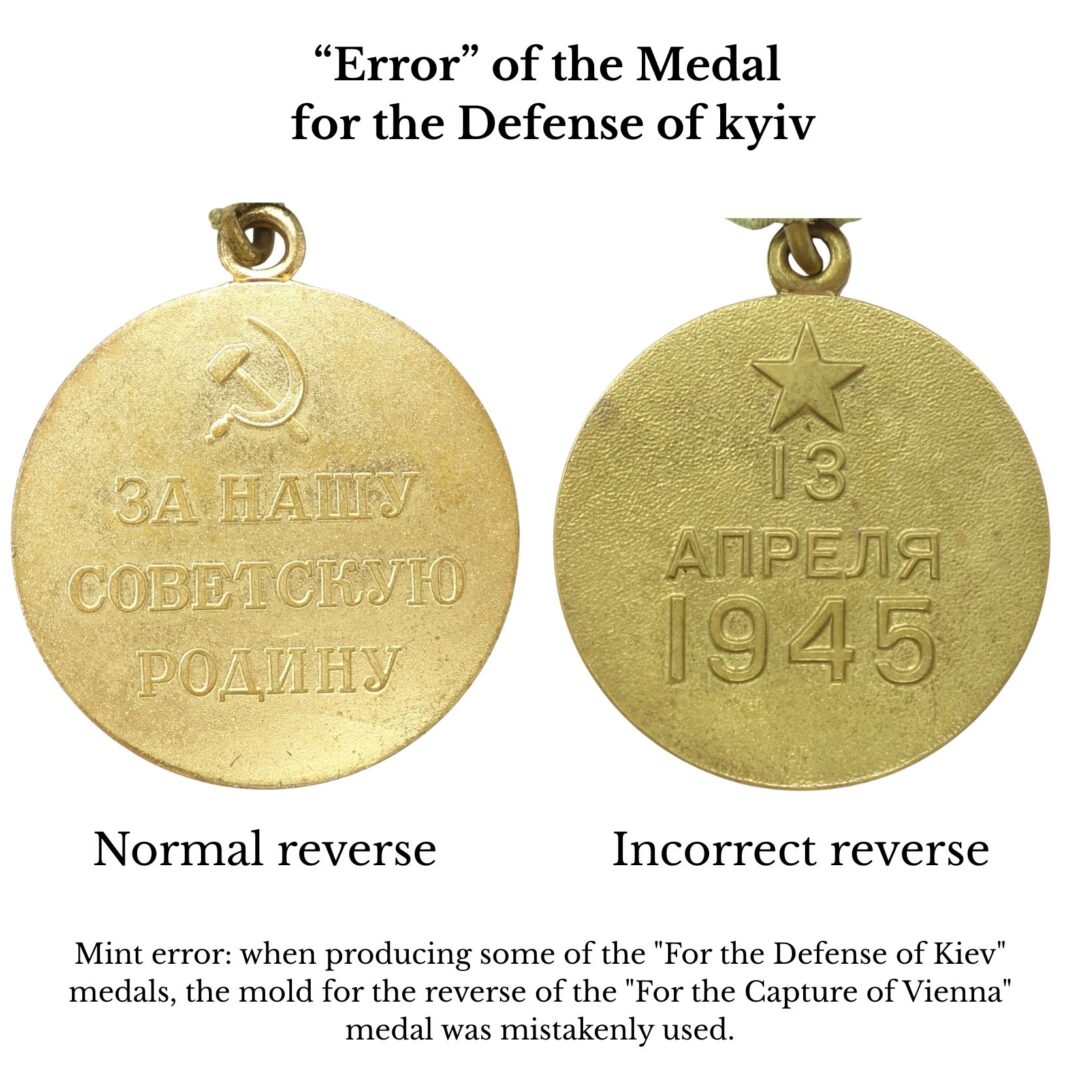
There are also examples featuring an incorrect reverse, the result of a minting error: during the production of some “For the Defence of Kiev” medals, the reverse die from the Medal “For the Capture of Vienna” was mistakenly used. Some collectors believe these medals with the erroneous reverse were intentionally produced for collectors interested in rare varieties.
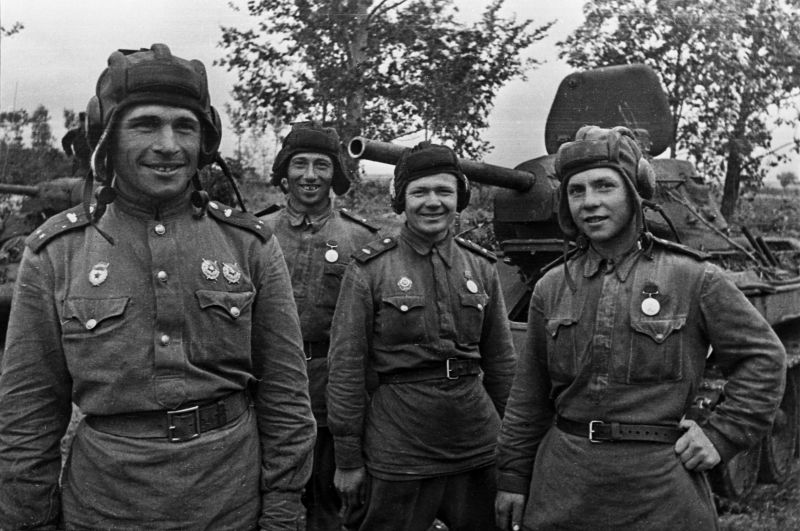
Soviet decorations from World War II are becoming increasingly sought after by collectors and, as a result, more and more counterfeits have appeared on the market.
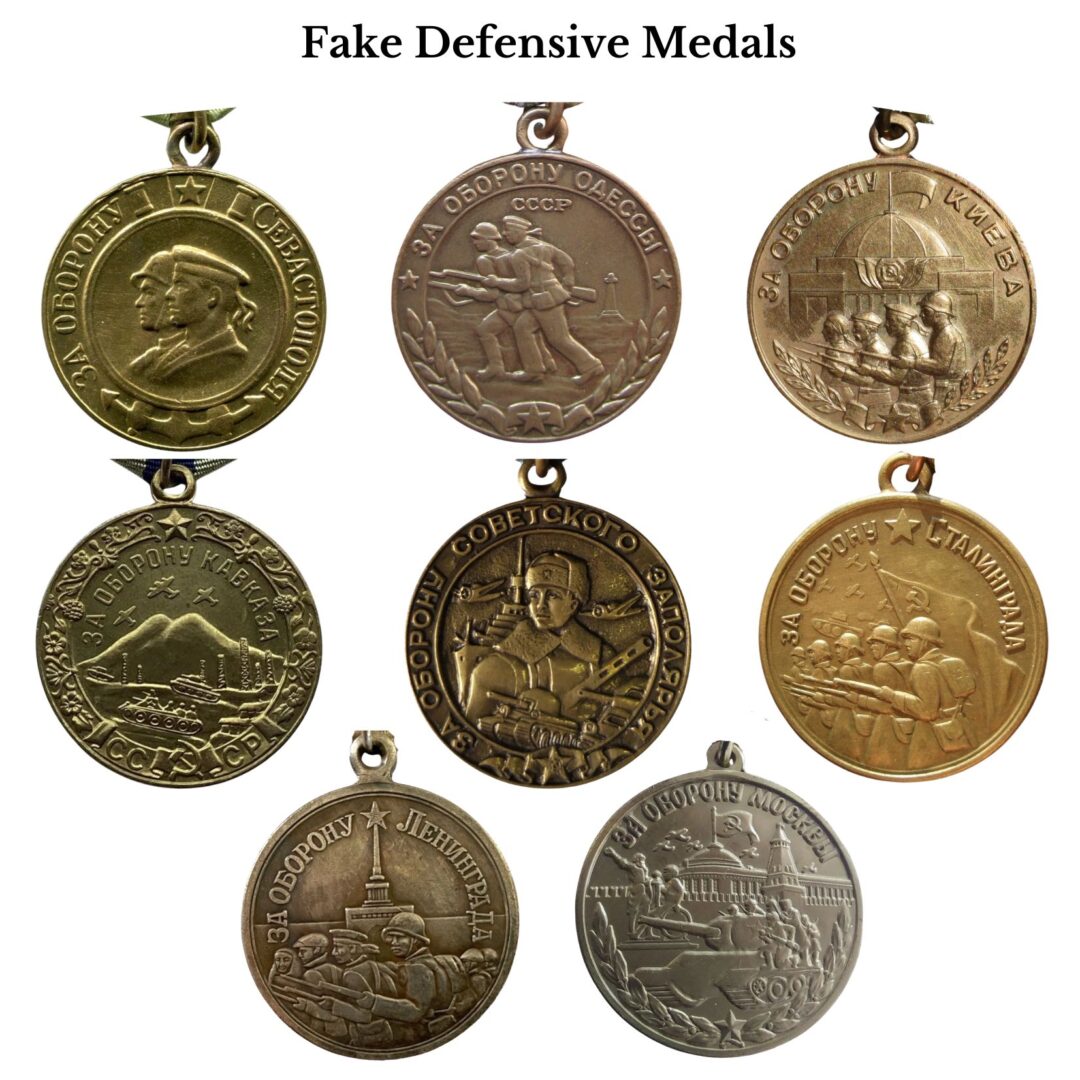
To distinguish an original medal from a reproduction, it is necessary to carefully examine the details and the manufacturing material. There is no quick method for authentication; each piece must always be studied thoroughly.
Fortunately, most forgeries are of poor quality and can be identified quite easily. However, collectors should be especially cautious with the Medals “For the Defence of Sevastopol” and “For the Defence of Odessa”; since they are the rarest examples, they are also the most frequently counterfeited.
In conclusion, the Soviet World War II Campaign Medals are historical items that have been proudly worn for many years on the uniforms of veteran soldiers of the Soviet Union and are now collected to continue remembering history.