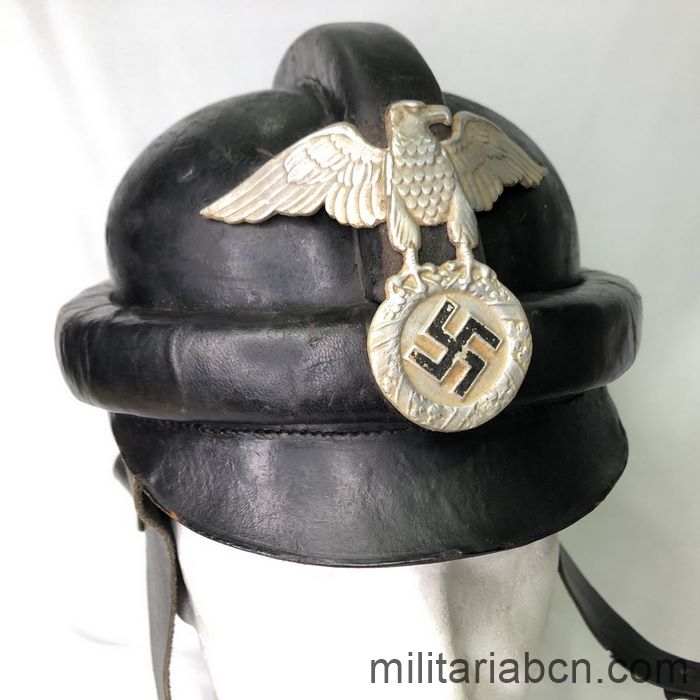
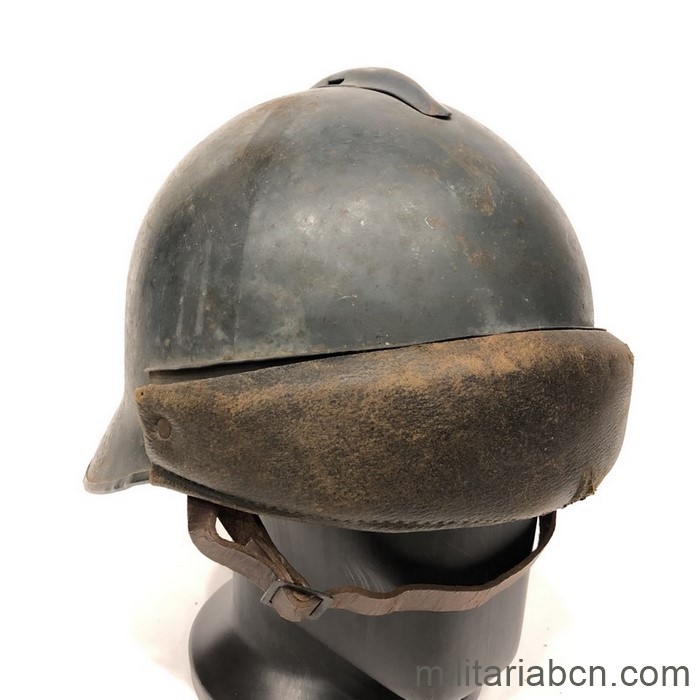
Germany, Third Reich. WW2 Luftschutz M38 “Gladiator” helmet manufactured in 1943.
In this example, the steel shell is marked “RL2 39/2,” referring to the Reichsanstalt für Luftschutz (Reich Air Protection Institute) and the year of approval, 1939. This rimless model is the variant manufactured in a single piece from 1943 onward by ET (Eisenhüttenwerk Thale), finished in blue. It retains its original liner and chinstrap.
The German Air Protection League was founded in late 1932 as a voluntary organization intended to provide civil defense against aerial bombardment in major cities. After Hitler came to power, it was reorganized and placed under the supervision of the Reich Ministry of Aviation, led by Hermann Göring, and in April 1933 it was renamed the Reich Air Protection League (Reichsluftschutzbund, RLB). Although membership was officially voluntary, in practice it became nearly compulsory, and from 1943 onward the integration of the entire civilian population—including women—into air protection service was required. By mid-1937, the RLB was structured into various specialized services, such as air-raid warning systems, security and rescue units, industrial protection, civil self-protection, and aircraft observation services.
Regarding equipment, Luftschutz personnel initially used a wide variety of reused helmets, including firefighter helmets, First World War models, obsolete military helmets, and examples captured from other European countries. Due to steel shortages and the priority given to the Wehrmacht, it was decided to create a specific helmet that was lightweight, economical, and would not interfere with military production. Thus the Luftschutz M38 helmet was born, nicknamed the “Gladiator” because of its distinctive design. Its development and use went through several stages between 1938 and the end of the war, reflecting the growing material constraints and changing needs of German civil defense during the conflict.
German helmet from the Second World War.