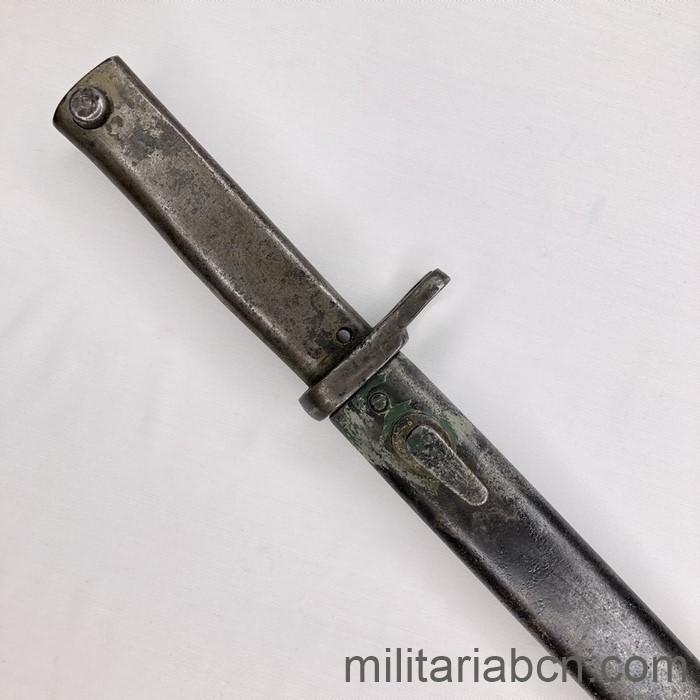
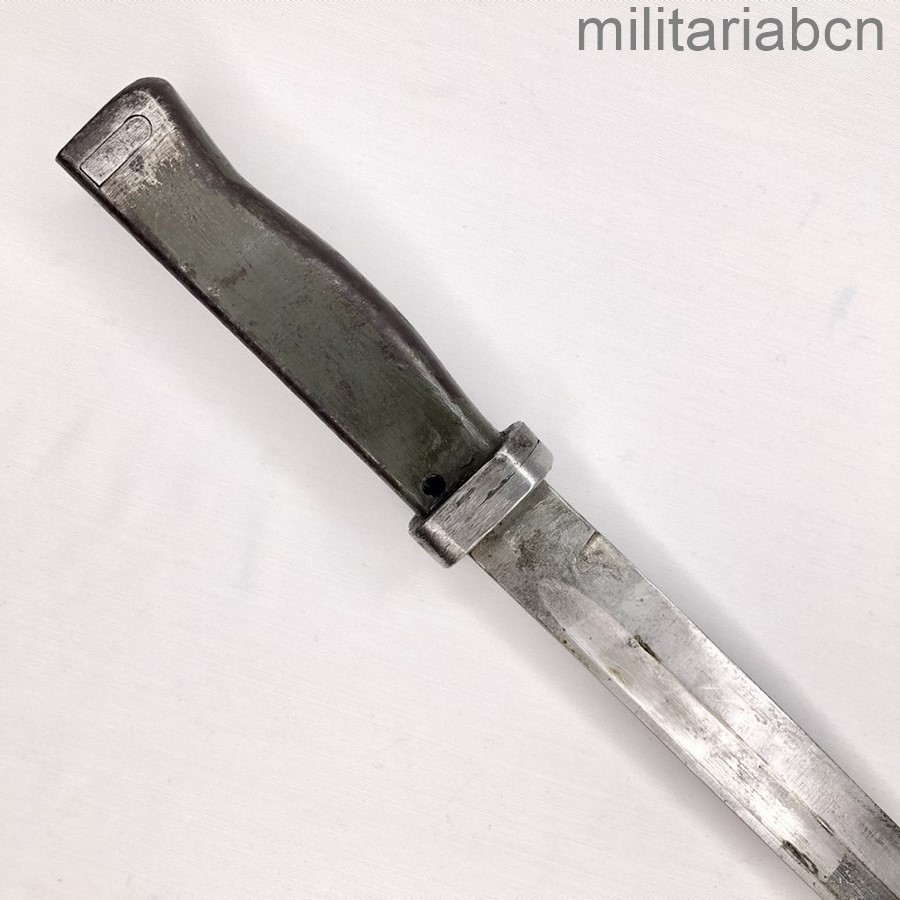
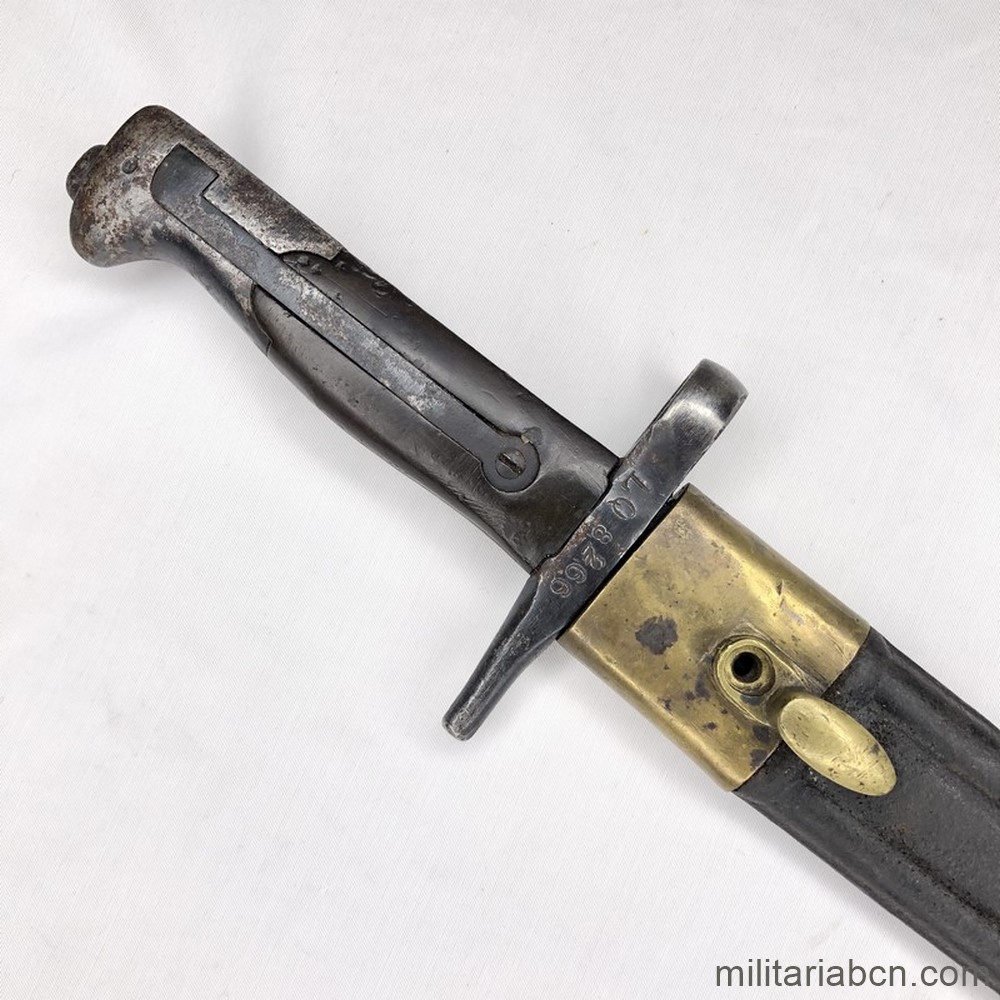
Imperial Germany. Short German M1898 bayonet from the 15th Infantry Regiment for the Mauser Model 1898 Rifle.
At the beginning of WW1 World War I, Model 1898 bayonets were shortened for practical reasons: firstly, in the trenches, it was difficult to use a long bayonet due to limited space; secondly, a shorter bayonet was less likely to bend or get stuck in an enemy’s body during combat or while working the trench soil. This bayonet is a shortened example.
On the blade is the marking «P. D. Lüneschloss, Solingen», referring to the manufacturer Peter Daniel Lüneschloss of Solingen. On the spine, it bears the monogram of Wilhelm II (Emperor of the German Empire from 1888 to 1918) and «W06», referring to the year of manufacture, 1906.
The guard has the inscription «15.R.3.170» from the 15th Infantry Regiment (2nd Westphalian) «Prince Frederik of the Netherlands», 3rd Company, Unit 170.
This unit was part of the 13th Division of the German Army. During World War I, the division served on the Western Front. It participated in the initial German advance through Belgium and France, culminating in the First Battle of the Marne. After a period of trench warfare in various sectors, the division moved to Verdun in 1916. Later that year, from September, it fought in the final stages of the Battle of the Somme. During the German Spring Offensive of 1918, the division took part in the Second Battle of the Somme. It later suffered under the subsequent Allied offensives, including the Meuse-Argonne Offensive. Allied intelligence rated it as a first-class division.
German bayonet from the First World War WW1.
Total length: 41 cm
Length without scabbard: 38.4 cm
Blade length: 25.1 cm