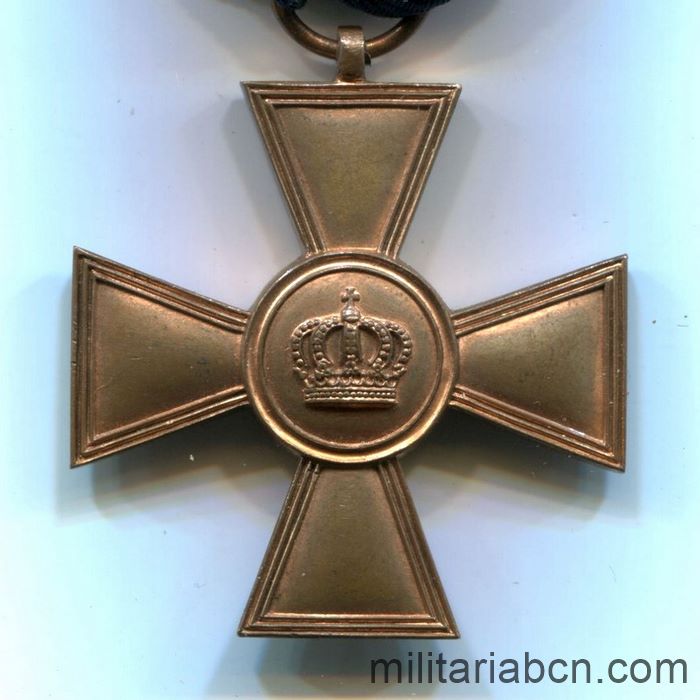
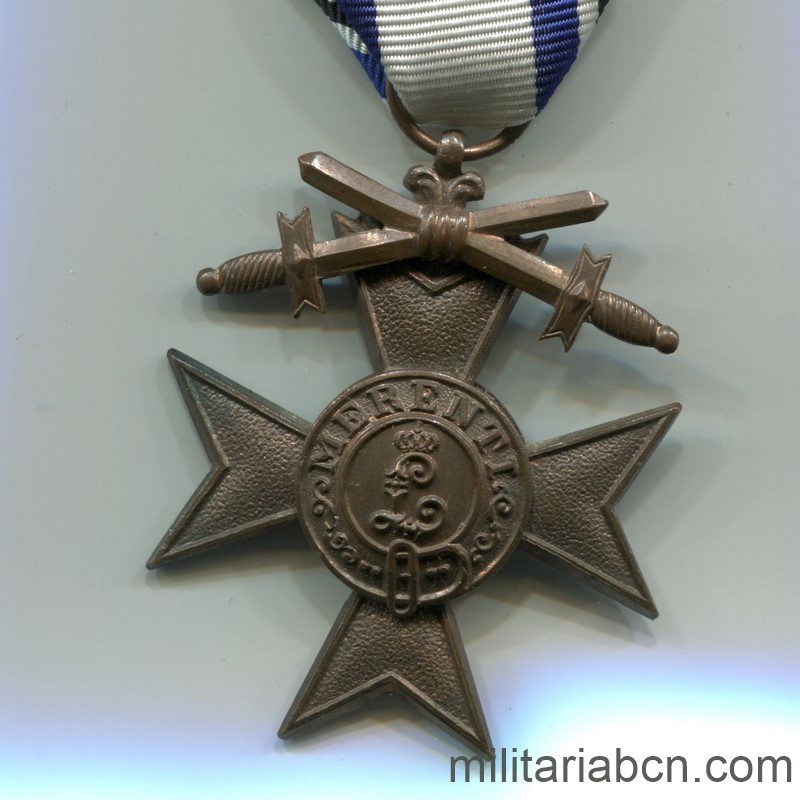
Imperial Germany. Bavaria. Military Merit Cross, 3rd Class. With swords. Replacement ribbon. Model 1913. Bavarian Military Merit Cross, 3rd Class.
The Military Merit Crosses were established by King Ludwig II along with the Military Merit Order on July 19, 1866. The Military Merit Order was established in five classes: Grand Cross, Commander, Knight 1st and 2nd Class, and the Military Merit Cross of the Order. The first form consisted of one class from 1866 to 1905. Its main characteristic is the blue enameled arms of the cross with silver borders. Swords were established for all classes in 1891 and were subsequently awarded for the wars of 1866 and 1870/71. The Officer’s Cross was established in 1900. The second form of the Military Merit Cross was awarded from 1905 (24 November) to 1913 and now consisted of two classes without enameled arms. These crosses were silver with granulated arms. The Military Merit Cross 1st Class had an enameled central shield, while the 2nd did not. From 1913, the Military Merit Cross was divided into three classes, with and without a crown. For wartime merit, swords were attached to the clasp on the upper arm of the cross. The 1st Class was made of silver-gilt or copper, the 2nd Class was made of silver or silver-plated nickel silver or copper, and the 3rd Class was copper-tinted. The 1st and 2nd Classes had enameled central shields on the obverse, while the 3rd Class was unenamelled.
The order could be awarded to all members of the Bavarian Army and to members of other armies who had provided outstanding service to the Army. The Peace Cross, without swords, could also be awarded to civilians for services rendered to the Army. During the First World War, merit often consisted solely of financial contributions. The best-known manufacturers of the crosses after 1889 were Hemmerle of Munich, Jacob Leser of Straubing, Deschler & Sohn of Munich, Christian Lauer of Nuremberg, and Weiss & Cie. of Munich. The Poellath company of Schrobenhausen was Hemmerle’s subcontractor.
Eight-pointed cross of copper or copper-plated non-ferrous metal. The arms of the cross are grained and have polished edges. The obverse and reverse feature a 17 mm round central shield. On the upper arm of the cross, between the points, is a stud with crossed swords. At the top end of the rivet is a spherical eyelet with a ring.
German World War I Medal