We use cookies on our website to give you the most relevant experience by remembering your preferences and repeat visits. By clicking Accept, you consent to the use of ALL the cookies. You can Modify or Reject the use of the cookies. See our cookie policy.
The Spanish military helmets used during the Spanish Civil War are among the most sought-after pieces in European militaria collecting. In this article, we examine the different official Spanish helmet models, their development, technical characteristics, production data and wartime use.
If you are looking to buy an original Spanish Civil War helmet for your collection, understanding the differences between the M21, M26 and M34/M38 models is essential. You can purchase an original Spanish Civil War helmet for your collection here:
Index
Historical Background: Spain and the Adoption of the Steel Helmet
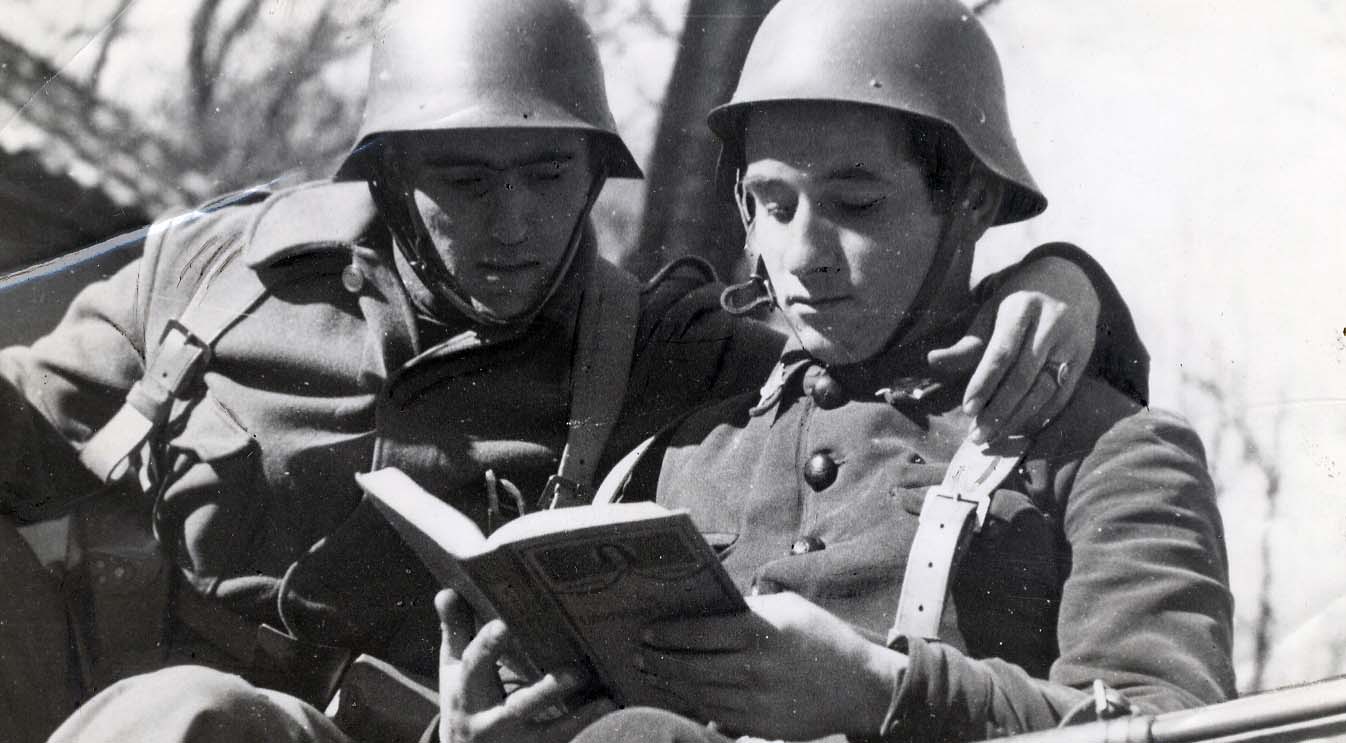
Soldiers wearing an M26 «brimmed» helmet reading.
During World War I, Spain remained neutral. Nevertheless, Spanish military observers closely followed the technological and tactical developments of the war, including the widespread adoption of steel combat helmets by European armies.
Unlike other nations, Spain had no immediate European enemies and its army was largely focused on internal security operations and colonial warfare in Morocco. For this reason, it continued using colonial sun helmets (salacot) and the regulation ros cap rather than adopting a steel helmet immediately after the war.
In the mid-1920s, under the 1926 Army Regulations, the Spanish General Staff began studying the adoption of a modern steel helmet to improve troop protection. An international competition was organized, and several designs were submitted. Two Spanish proposals stood out:
Hijos de B. Castells (Barcelona, Catalonia) presented a helmet inspired by the French Adrian Model 1915. Although functional, it was handmade and unsuitable for industrial-scale production.
The Fábrica Nacional de Artillería (Trubia, Asturias) developed a prototype under Commander Antonio Ramírez de Arellano. The result was the “Combat Helmet Model 1926,” with 150 test units produced. The design showed similarities to the Austrian Berndorfer helmet and featured dome ventilation.
Although the prototype passed ballistic tests, it was initially rejected. Development continued, resulting in two definitive versions: the M26 brimless and the M26 brimmed helmets.
In 1930, approximately 12,000 units of the brimless version (commonly known among collectors as the M21) and 1,500 units of the brimmed version were produced.
In 1931, a further 20,000 helmets were manufactured, this time exclusively of the brimmed M26 type.
That same year, the monarchy ended and the Second Spanish Republic was proclaimed. Political instability during the Republic — including the 1934 Revolution and violent clashes in Asturias and Catalonia — led to the development of a lighter helmet for security forces.
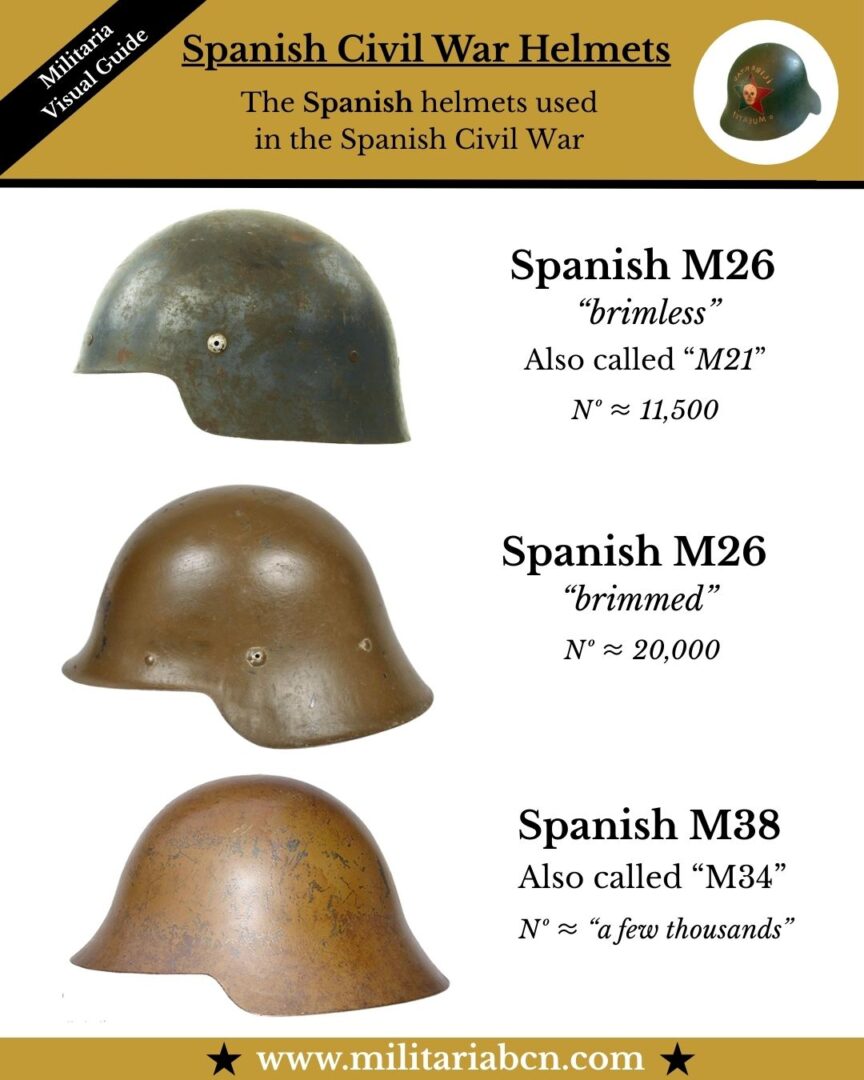
In July 1936, following the uprising led by Francisco Franco, the Civil War began. At that time, three main Spanish helmet models were in service: M34 / M38, M21 / M26 “Brimless”,M26 “Brimmed”.
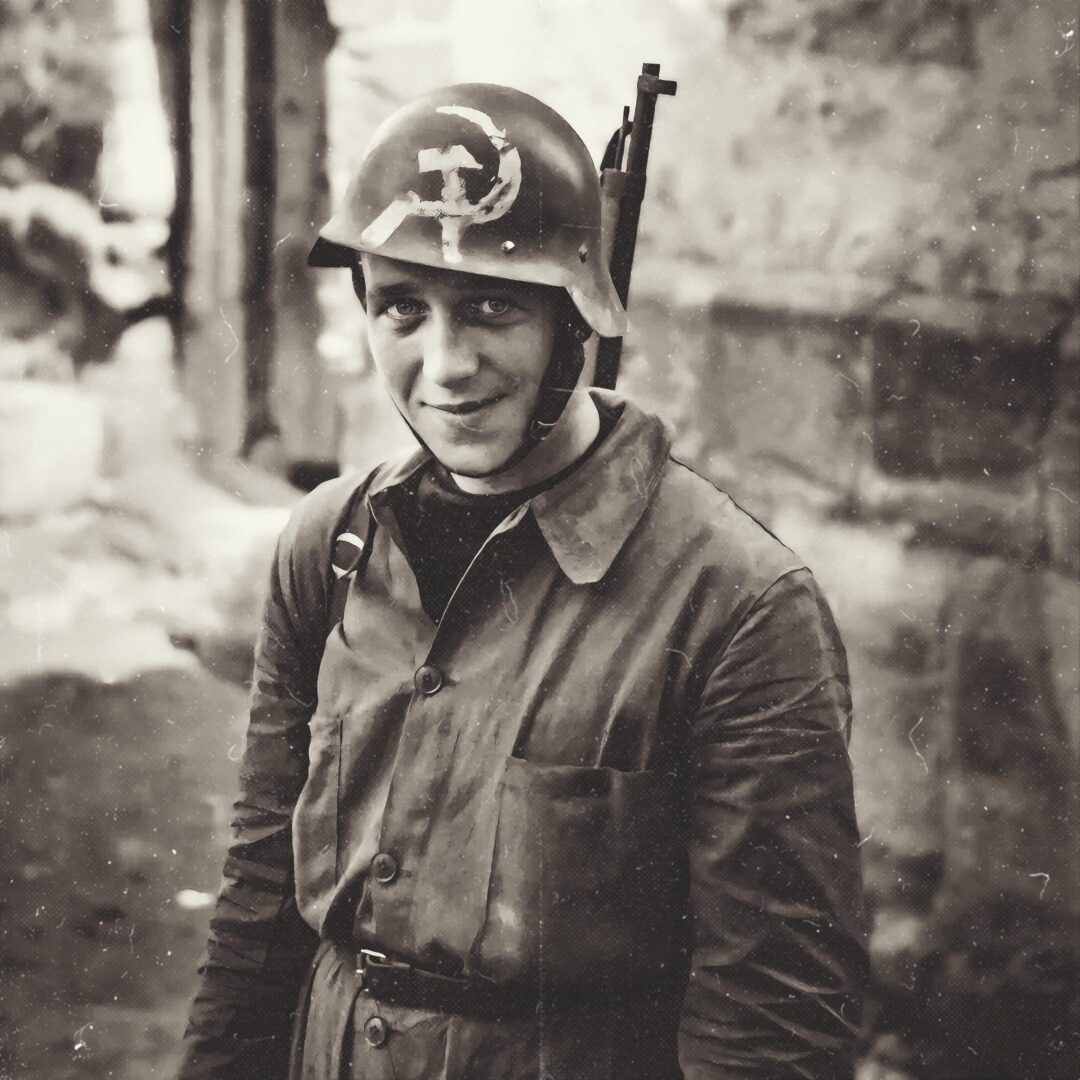
Republican soldier wearing an M26 «brimmed» helmet painted with the hammer and sickle.
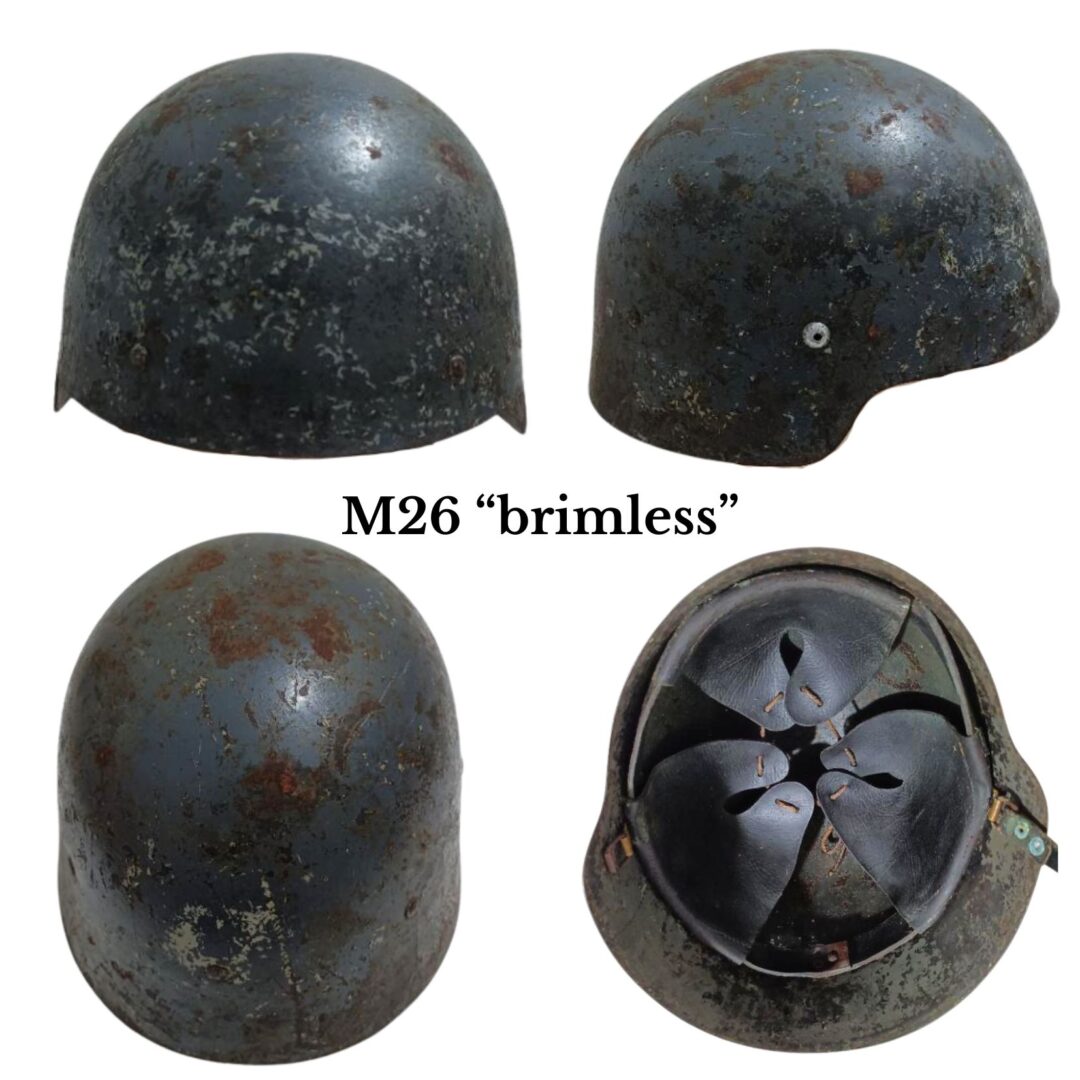
M21 or M26 “Brimless” Helmet
The M26 brimless helmet, commonly referred to as the M21 by collectors, is one of the most distinctive Spanish Civil War helmets. The reason for the M21 designation is unknown and somewhat confusing, yet it remains the most commonly used term.
Technical Characteristics
Manufactured in 1930 at Trubia
German Röchling steel and Spanish Trubia steel
Thickness: 1.1 mm
Weight: approximately 1,000 g
Single size production
No visor or extended rim
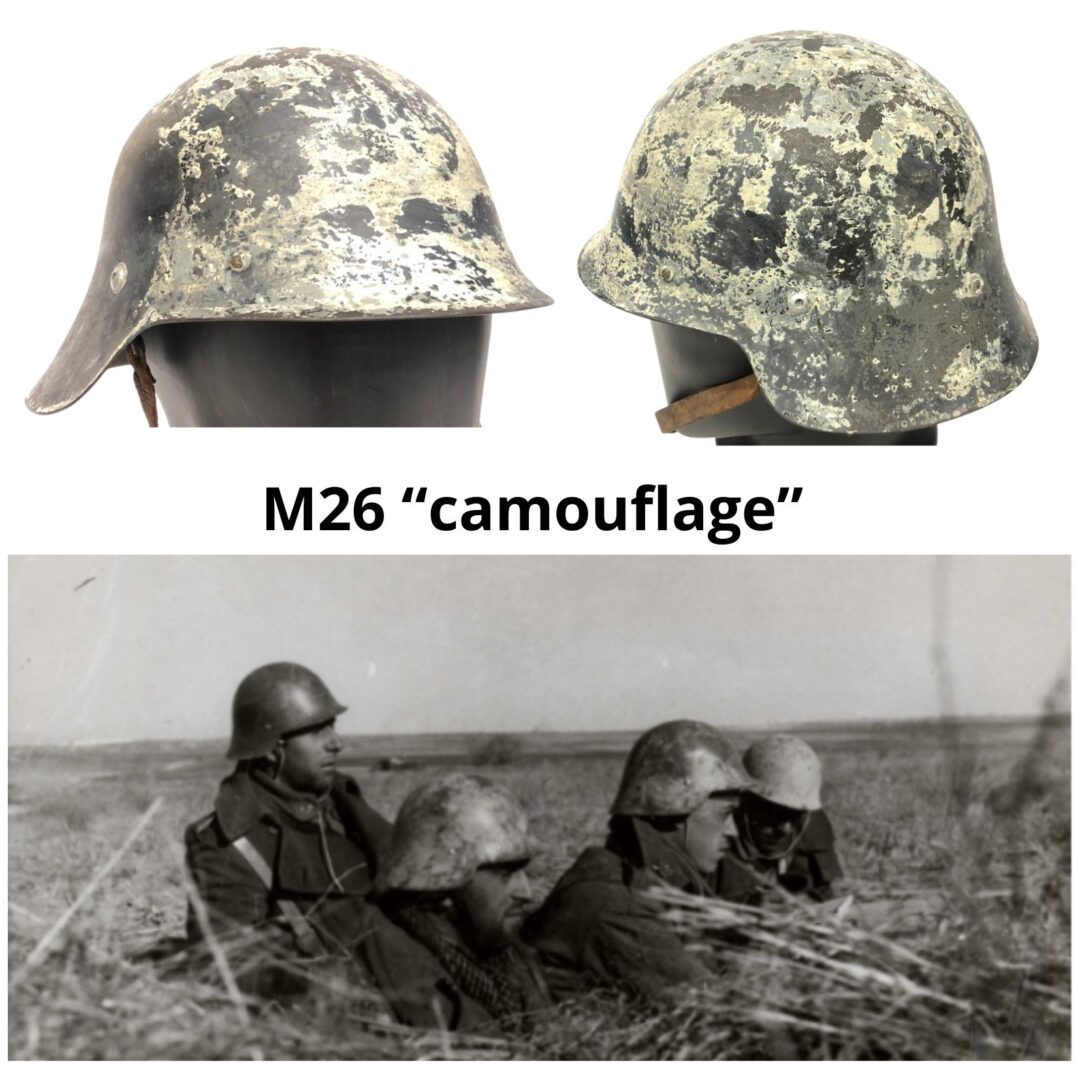
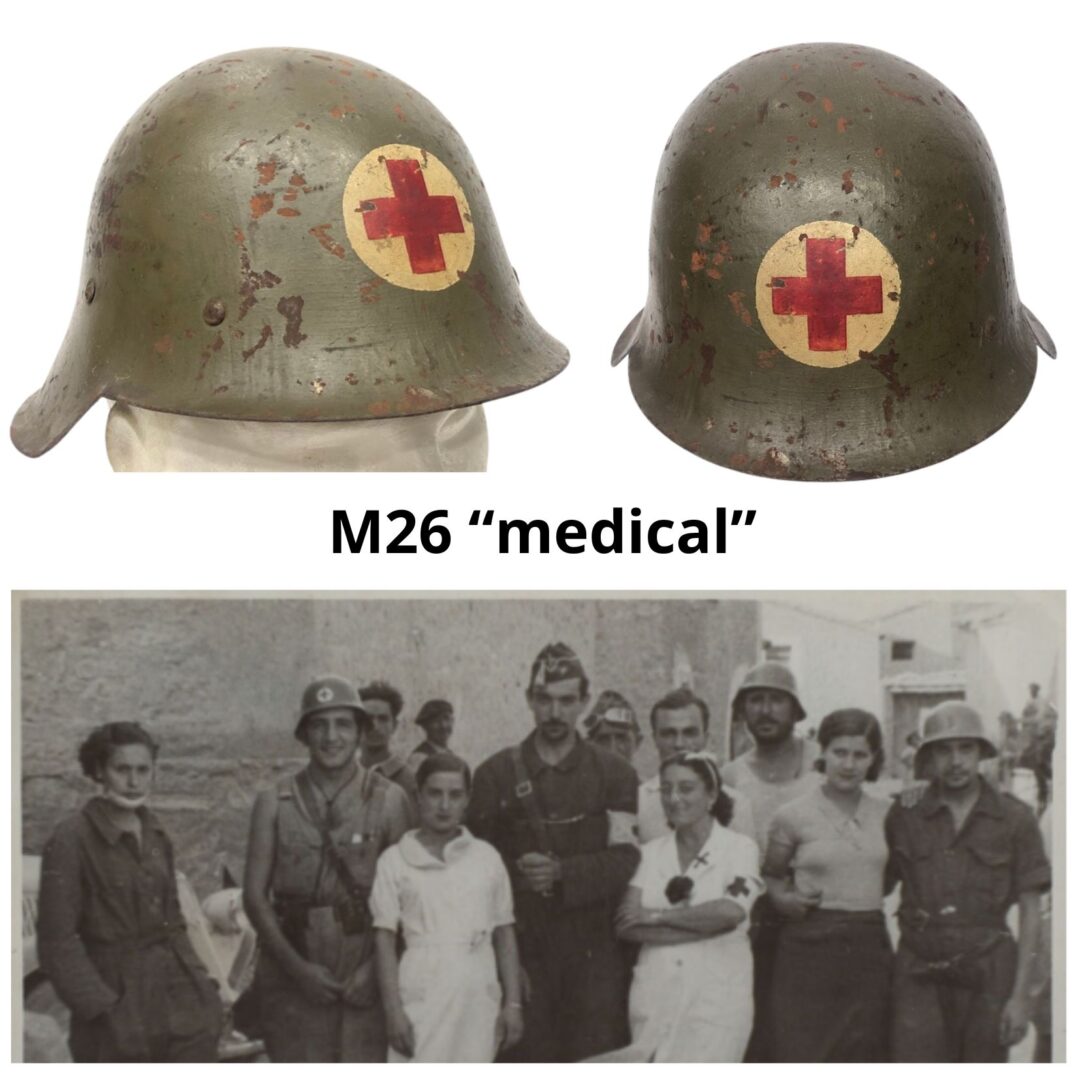
Originally factory-painted grey, many examples were repainted during the Civil War in green or khaki. Period photographs show numerous helmets decorated with militia insignia, slogans and political symbols from both Republican and Nationalist forces.
Construction Details
Seven aluminum rivets (two larger, ventilated)
Leather liner band attached by rivets
Three double leather tongues joined by a cord
Felt padding for comfort
Simple leather chinstrap with brass fittings
Due to repainting and postwar refurbishment, untouched original examples are increasingly rare.
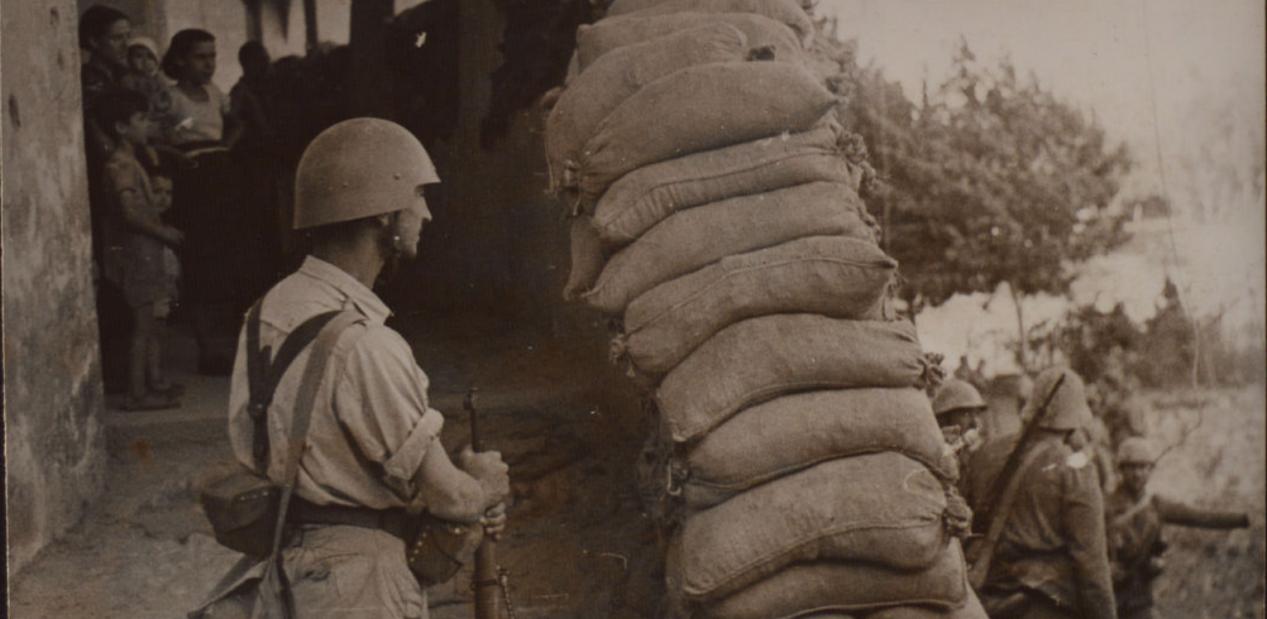
Republican soldier wearing an M26 «brimless» helmet on the Madrid Front.
M26 “Brimmed” Helmet
M26 “Brimmed” Helmet
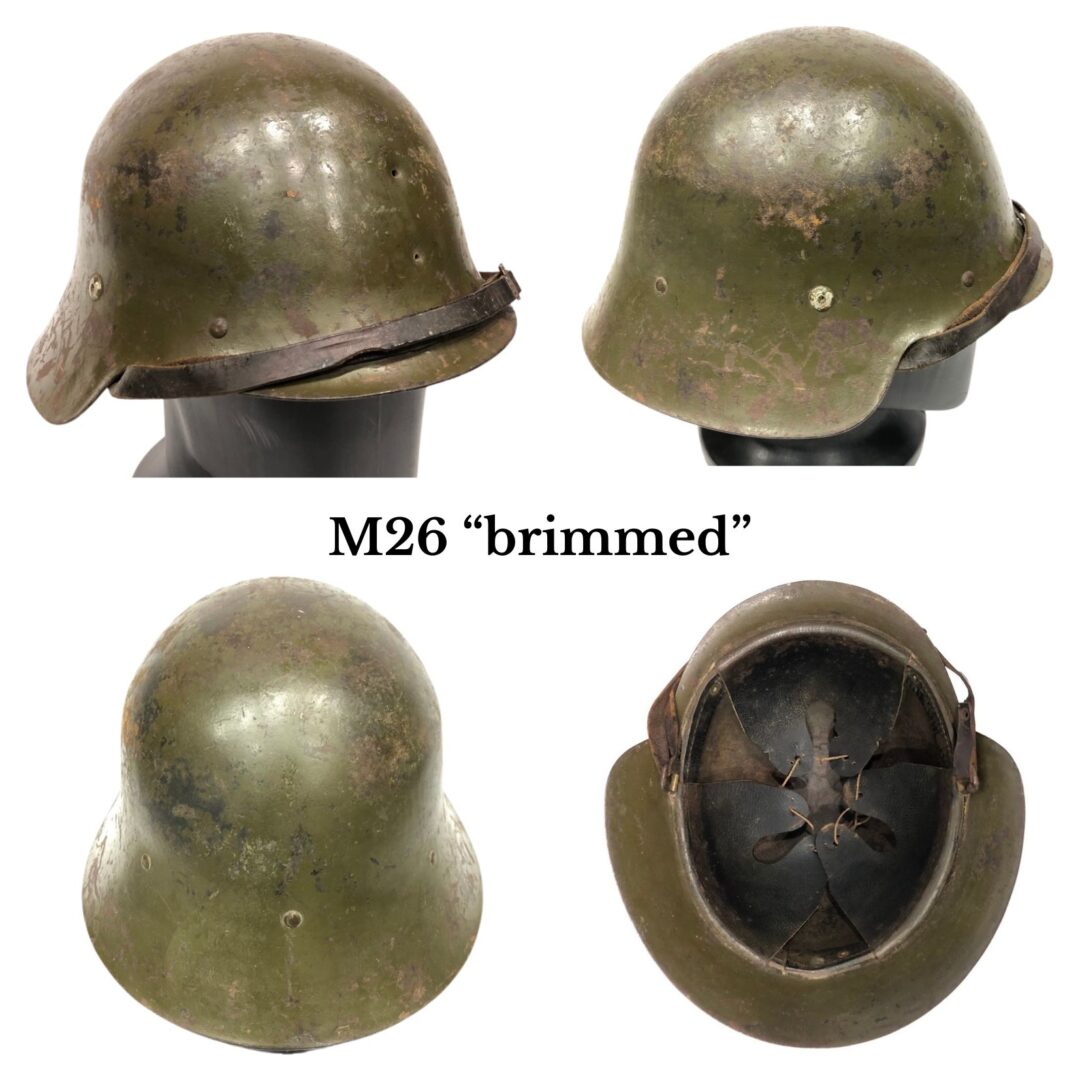
The M26 brimmed helmet represents the more developed version of the Spanish Model 1926.
Technical Characteristics
Produced in 1930–1931
Laminated steel (1.1–1.8 mm thickness)
Weight: approximately 1,050 g
Single size
Distinct front visor and flared rim
Like the brimless version, it was originally painted grey and later repainted during wartime.
Interior and Construction
Seven aluminum rivets (two ventilated)
Leather liner system identical in structure to the M21
Interior painted black (main difference from brimless version)
Standard leather chinstrap
The brimmed model eventually became the dominant Spanish Army helmet before and during the early stages of the Civil War.
Model 34 / Model 38 Helmet
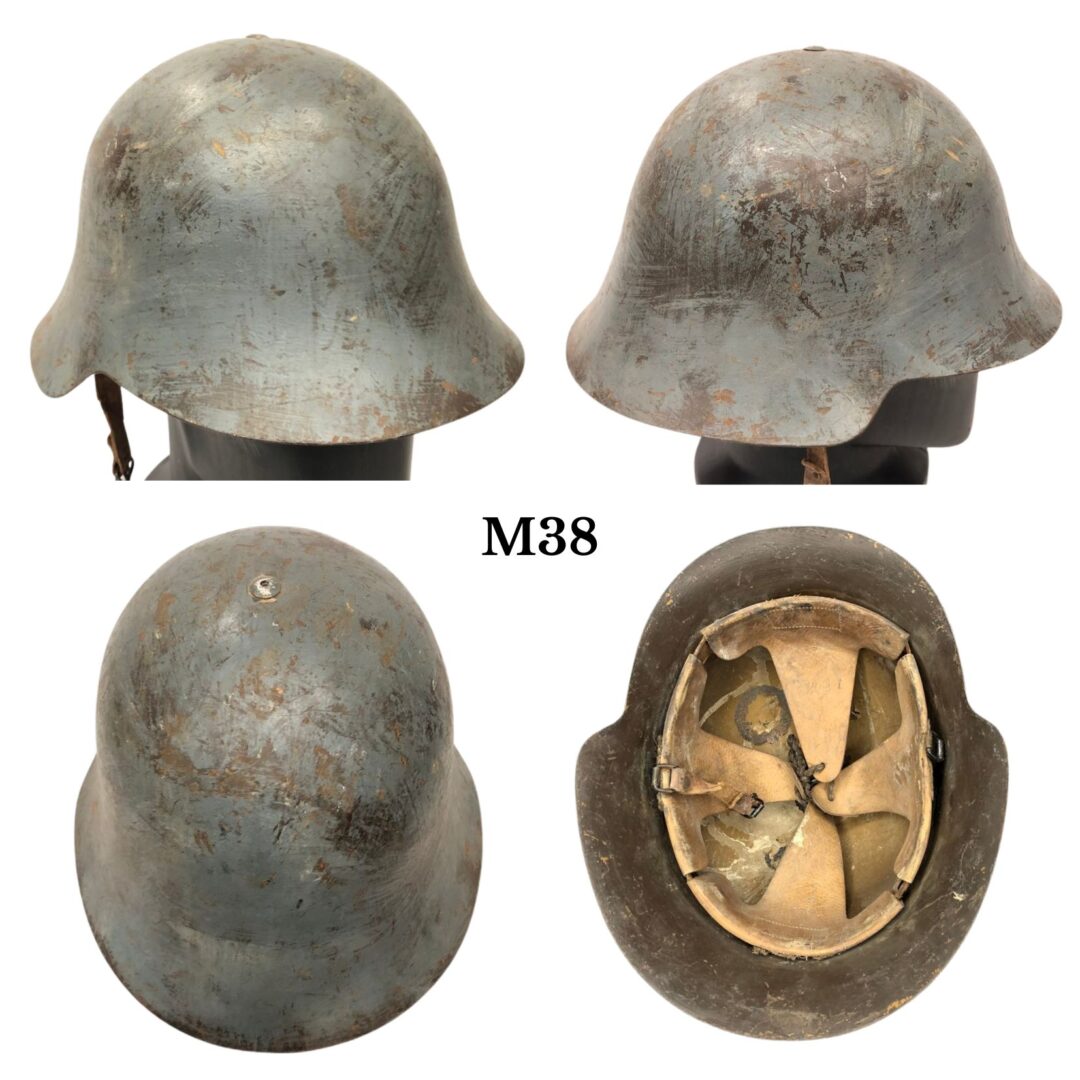
The M34 (production year) or M38 (distribution year) was developed from 1934 primarily for State Security Forces.
However, due to shortages of steel helmets during the Civil War, it was also used in combat roles.
Technical Characteristics
Laminated steel (1 mm thickness)
Manufactured by Acerías Guevara AHV (Trubia) and Cogue et Ansaldo (Italy)
Weight: approximately 930 g
Original color: khaki brown
Taller, more elongated dome
More oval interior shape
Single top rivet
Interior System
Simplified steel liner structure
Leather liner band with four leather tongues
Felt reinforcement
Longer leather chinstrap
Ballistic protection was inferior to the M26, being designed primarily for lighter threats.
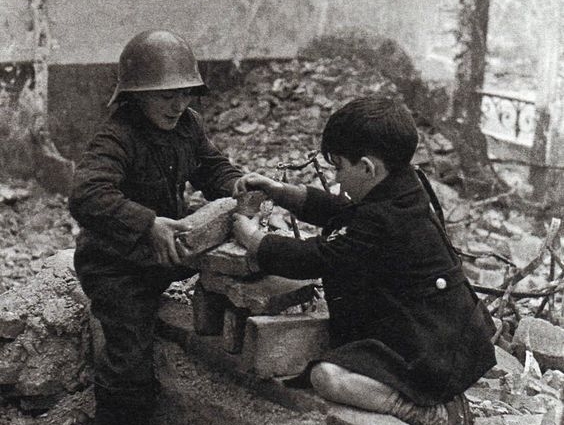
Children playing among the ruins of a bombing.
Postwar Recovery Campaign and 1943 Regulation
After the end of the Spanish Civil War, the Francoist regime launched a recovery campaign to re-equip the new army. All three helmet models were refurbished and reissued.
Refurbishment typically included:
Repainting in dark khaki or olive green
Replacement or repair of liners
New leather chinstraps
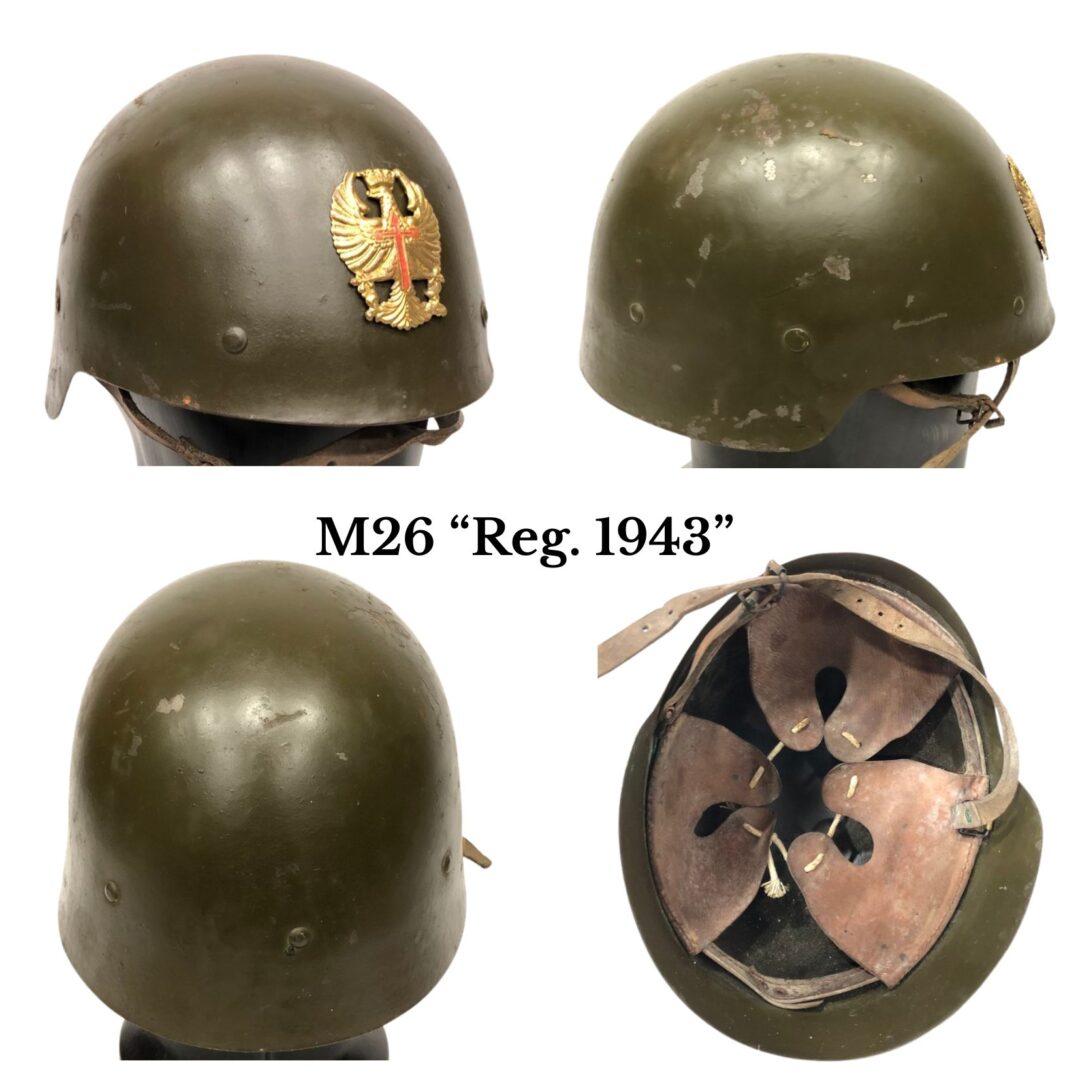
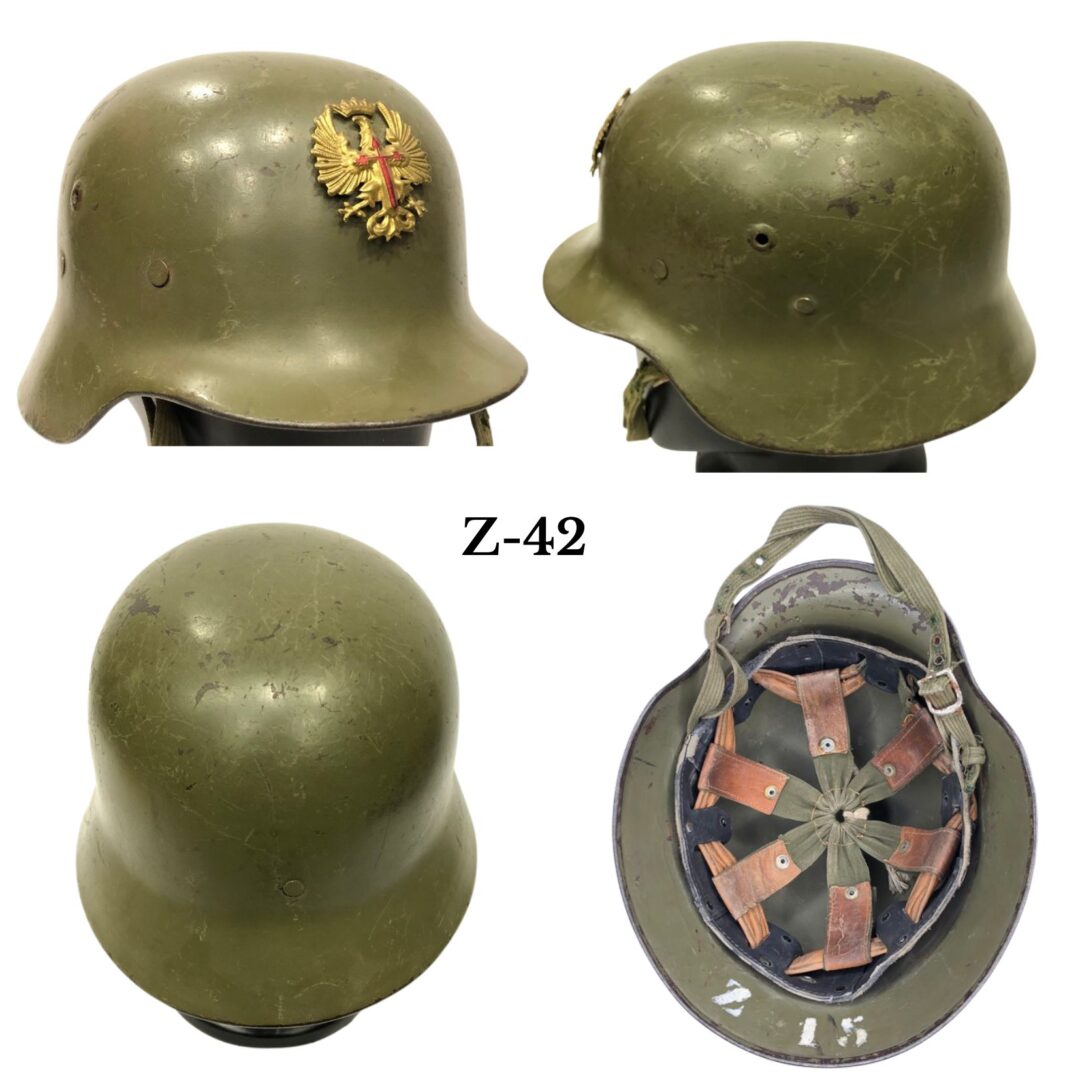
With the 1943 Regulation, a front clip was added to hold the Spanish Army eagle emblem (eagle with the Cross of Saint James, not to be confused with the Eagle of Saint John).
Although later replaced by the Z-42 helmet, the M21, M26 and M34/M38 remained in service into the 1950s and, in some cases, even into the 1970s.
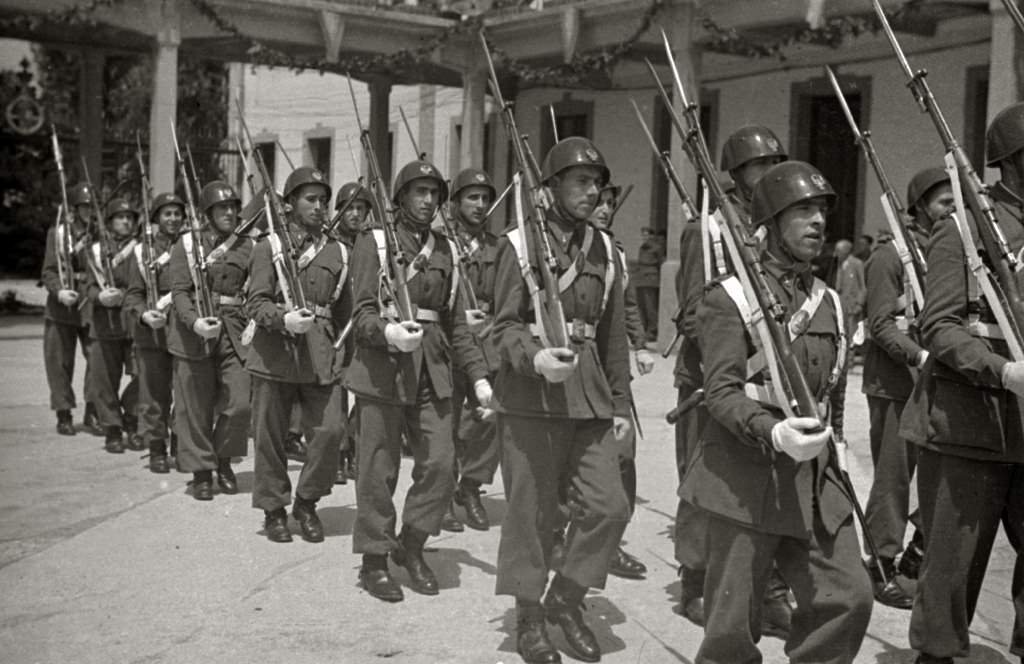
Spanish Army soldiers wearing Italian M33 helmets with the front insignia of the 1943 Regulations.
Why Spanish Civil War Helmets Are Highly Collectible
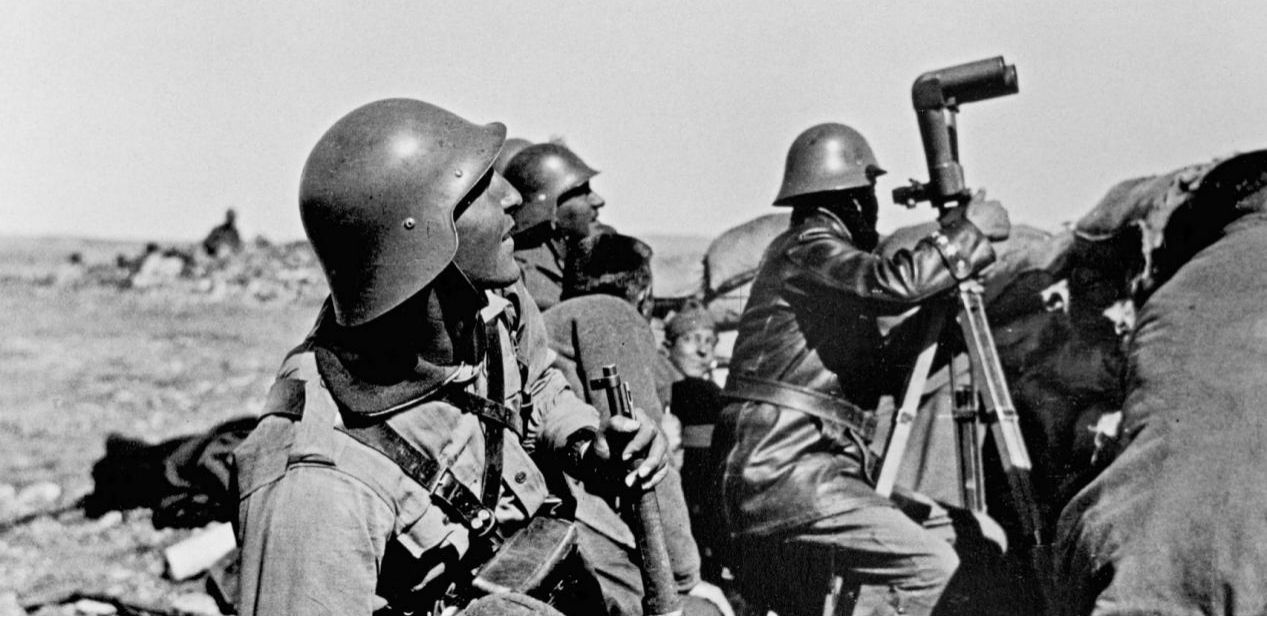
Soldiers in the trench wearing M26 «brimmed» helmets.
Spanish Civil War helmets are highly valued in militaria collecting for several reasons:
Wide variety of wartime repainting and field modifications
Hand-painted militia insignia and political emblems
Limited original production numbers
Extensive postwar refurbishment
As a precursor to World War II, the conflict also served as a testing ground for the Soviet Union, the International Brigades, Nazi Germany and Kingdom of Italy, increasing international historical interest.
Because many helmets were repainted, captured, modified at the front, or refurbished after the war, finding completely original, untouched Spanish Civil War helmets today is exceptionally difficult — which significantly increases their collector value.
BEWARE! The market is full of helmets repainted with colorful drawings and slogans from both the Republican and Francoist sides; most of them are modern restorations.
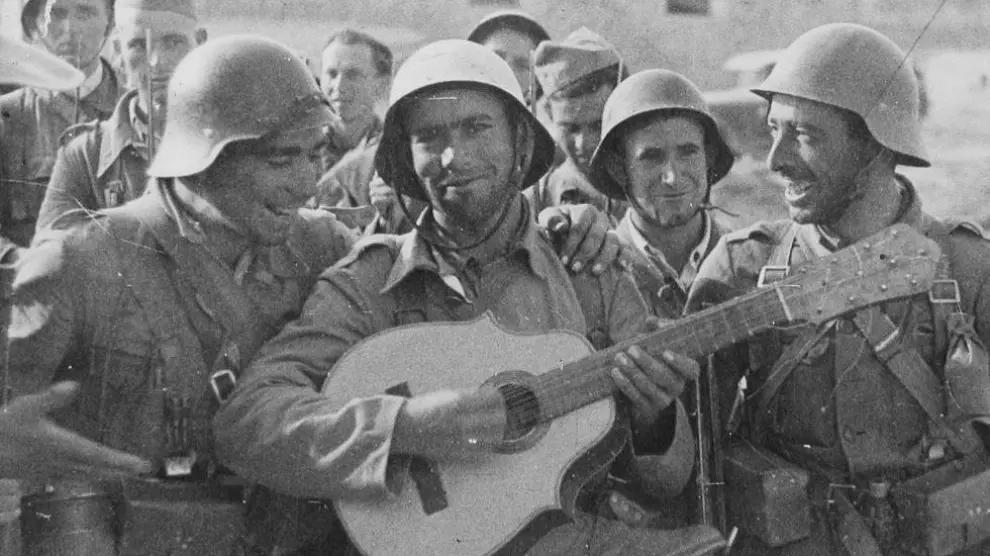
Soldiers wearing M26 «brimmed» helmets playing guitar.
FAQs
What helmets were used during the Spanish Civil War?
The Spanish military helmets used were the M26 «brimless» or M21, the M26 «brimmed», and the M34 or M38, the standard-issue helmets of the Spanish Army during the Second Republic.
Did the Republican Army and the Nationalist Army use the same helmets?
Partly, yes. Both armies used the M26 and M21 helmets available in their barracks at the start of the Spanish Civil War. Furthermore, the Nationalist Army received Italian M33 and German M35 helmets; and the Republican Army received Czechoslovakian Vz30, French M15 and M26 helmets, and, to a lesser extent, Soviet SSh36 helmets.
Where to buy original helmets from the Spanish Civil War?