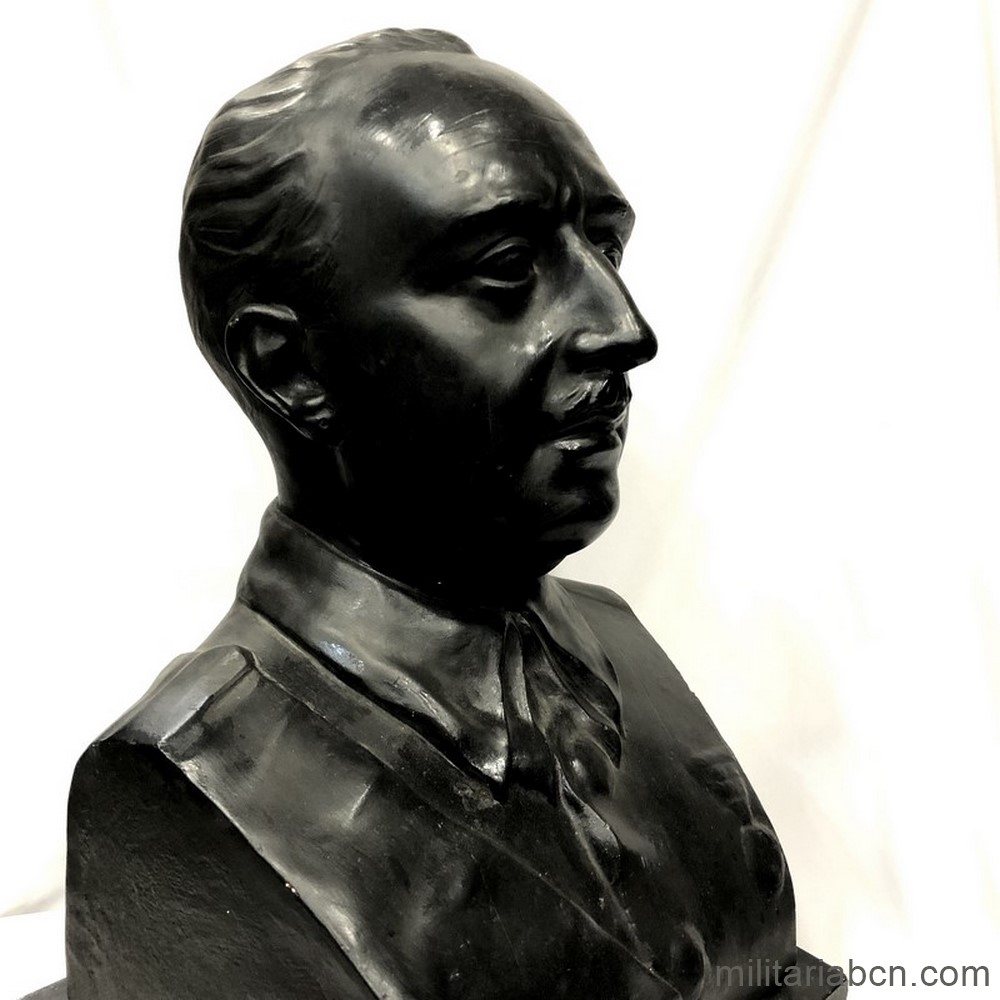
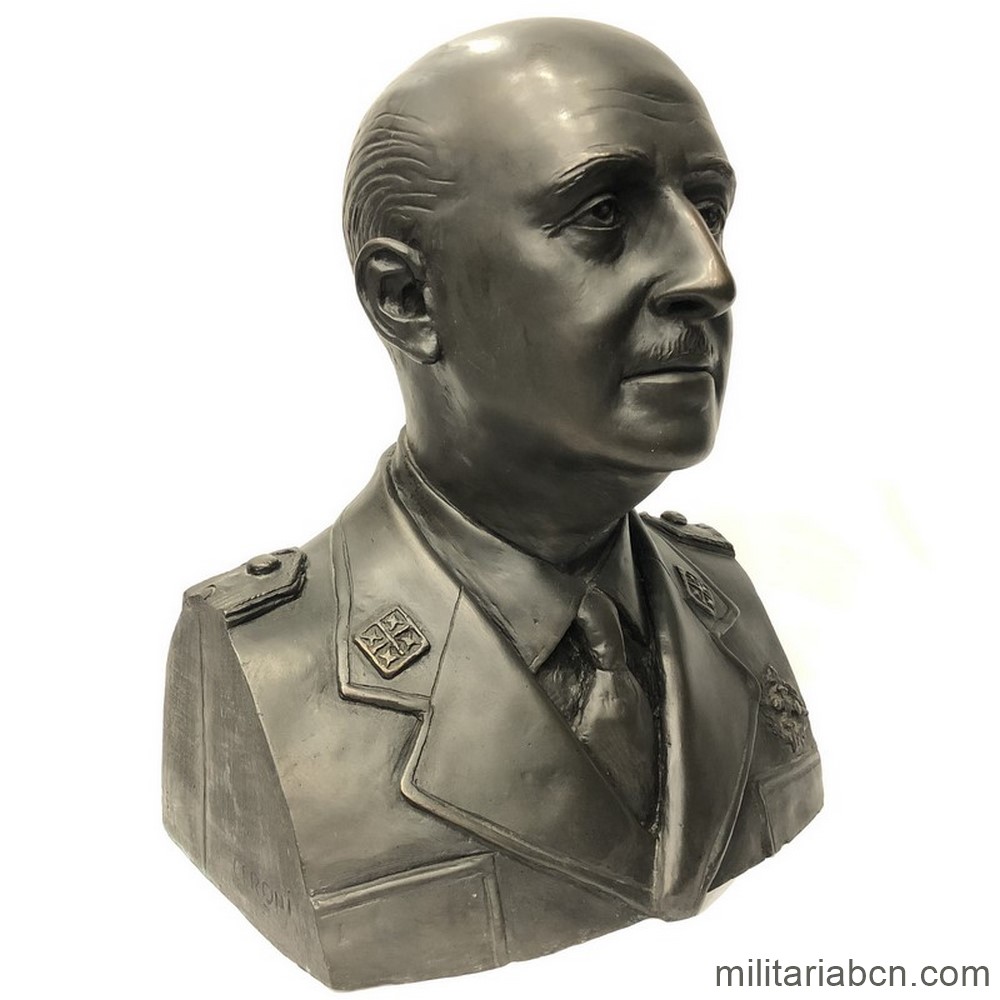
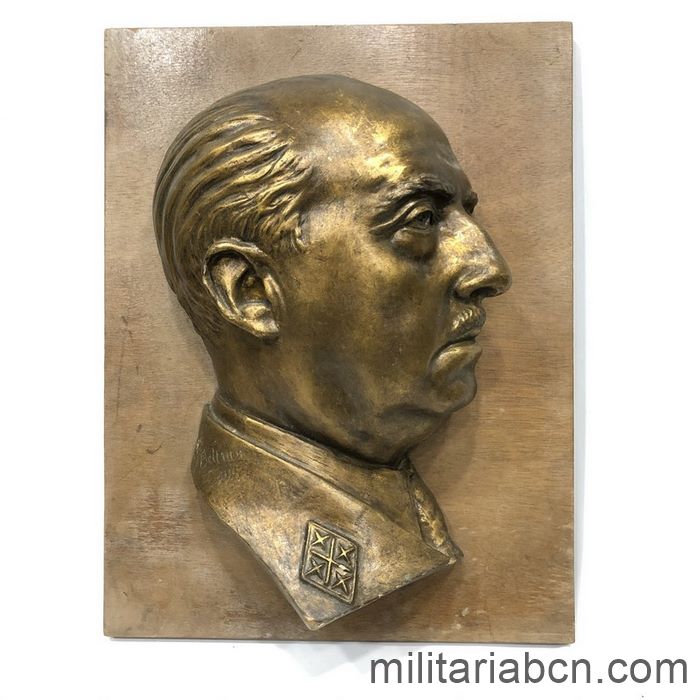
Spain. Bust of Francisco Franco in bronze by the sculptor Fructuoso Orduna Lafuente. 1943. Measurements 61 cm wide, 63 cm high and 32 cm deep. Franco wears on his chest the Laureate of San Fernando, the Yoke and Arrows and the emblem of the Spanish Legion. On his neck he already wears the insignia of Generalissimo or Captain General (three stars).
Fructuoso Orduna Lafuente (Roncal, January 23, 1893 – Pamplona, August 27, 1973) was a Spanish sculptor specialized in «urban sculpture» and winner of several awards for his outstanding work. He belongs to the first generation (1890-1920) of contemporary Navarrese sculptors following the criteria established by the doctor in Art History, Francisco Javier Zubiaur Carreño2 and continued by Professor José María Muruzábal in his unpublished doctoral thesis on «Public Sculpture in Navarre». He is included in the generation of artists who, «starting from classicist formulas, gave their works an air of universality and Europeanism, always within the path marked by plastic figuration»
In 1914 he moved to Madrid and entered the School of Arts and Crafts, working and perfecting his skills in the workshop of the sculptor Mariano Benlliure. In 1917, with the help of the Provincial Council of Navarre, he set up a studio in Madrid, on Calle Atocha, and again with the help of the same provincial council, three years later, he travelled to Rome where he stayed between 1920 and 1922.
Back in 1923, he settled in Madrid, holding an exhibition at the end of that year at the Museum of Modern Art. In 1924 he married Carmen Ballestero, from whom he had a daughter, Pilar. Although he worked in the Spanish capital, he maintained his ties with Navarre and in 1932 he was commissioned to create the new façade of the Provincial Council Palace on the new Avenida Carlos III that was opening up with the development of the Second Expansion of Pamplona.
He developed a professional career focused on various genres such as portraiture, religious imagery and monumental decoration. He combined his artistic side with teaching as a modelling teacher at the Madrid Ceramics School, first, and then at the Special School of Painting, Sculpture and Engraving.
On May 1, 1962, he was appointed Academician of Fine Arts in Madrid, where he resided permanently, replacing Moisés H