France. Napoleonic Period. Sword Attributed to a Member of the Institut d’Égypte. Egyptian Campaign (1798–1801).
Presentation sword attributed to a member of the Institut d’Égypte (Institute of Egypt), a scientific and cultural institution founded by Napoleon Bonaparte on 22 August 1798, during the French expedition to Egypt (1798–1801). The sword features mother-of-pearl grip scales, a gilded and chiselled brass hilt, Egyptian-inspired decoration and a triangular-section blade manufactured in Solingen, Germany.
The grip is fitted with mother-of-pearl scales, decorated with a representation of Isis Pharia, a figure associated with the Egyptian goddess Isis and her role as a protector of navigation and seafarers. This decorative motif reflects the growing interest in ancient Egyptian iconography that developed in France during the Napoleonic expedition.
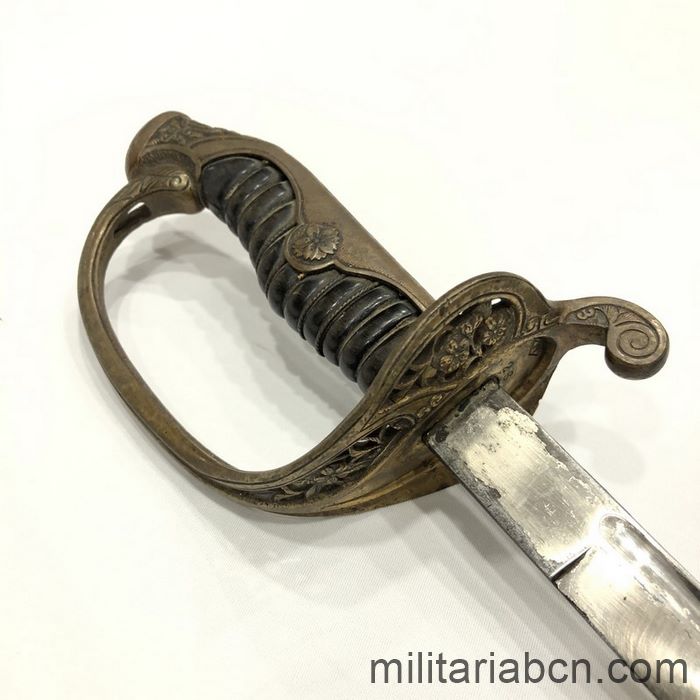
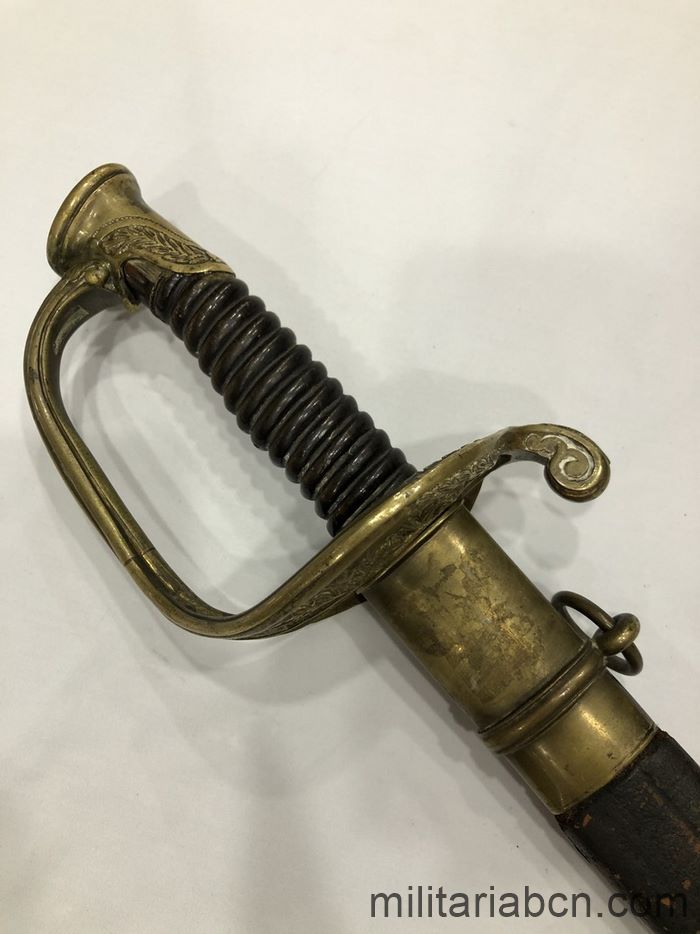
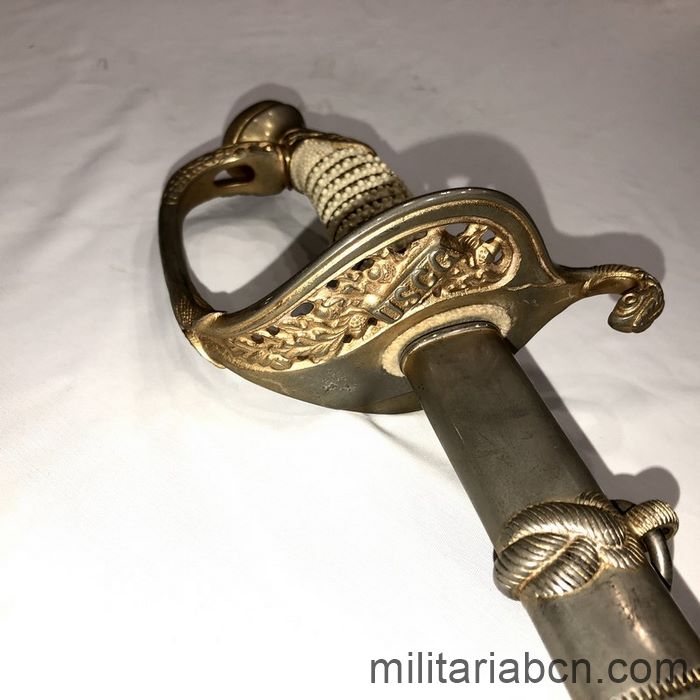
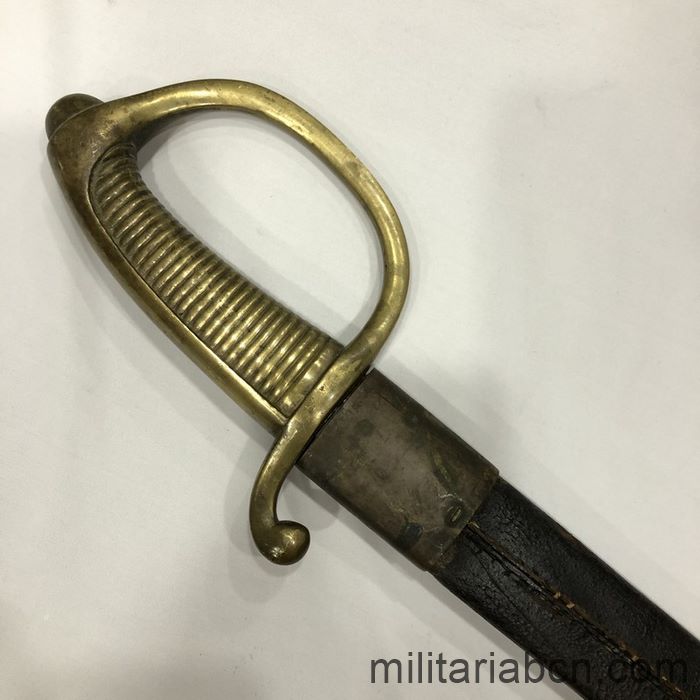
The hilt is made of gilded and chiselled brass, with a single-quillon guard decorated with fleurs-de-lis. The guard’s central escutcheon features finely chiselled and pierced decoration in the form of a palmette, a classical ornamental motif widely employed in the decorative arts of the late 18th and early 19th centuries.
The blade is straight, of triangular section. It retains engraved and gilded decoration on its upper third, characteristic of presentation and dress swords of the period. The blade exhibits numerous nicks along its cutting edges, significantly affecting its condition.
Total length 81 cm. Blade length 68.50 cm.
The scabbard is missing.
The Institut d’Égypte was established in Cairo on the initiative of Napoleon Bonaparte during the French military campaign in Egypt. Its purpose was to bring together scientists, engineers, naturalists, mathematicians, physicians, artists and other specialists to study Egypt through various disciplines, including archaeology, history, geography, natural sciences and the arts.
The institution formed part of the scientific and cultural dimension of the French expedition, accompanying the military operations conducted between 1798 and 1801. The work of its members made an important contribution to European knowledge of Egypt and provided much of the material subsequently published in the monumental Description de l’Égypte.
The combination of Egyptian motifs, classical ornamental elements and gilded brass fittings is consistent with the artistic and cultural environment of France during the late Directory and Consulate periods, when Bonaparte’s expedition encouraged the spread of so-called Egyptomania in the decorative arts.
In terms of its form and decoration, this sword is associated with the presentation and dress weapons used by civilian, scientific and administrative figures in the late 18th and early 19th centuries.
French presentation sword attributed to a member of the Institut d’Égypte, Napoleonic period, circa 1798–1801. Mother-of-pearl grip scales with Isis Pharia motif. Gilded and chiselled brass hilt, single quillon decorated with fleurs-de-lis and pierced palmette escutcheon. Straight triangular-section Solingen blade with engraved and gilded decoration on the upper third. Numerous blade nicks. Without scabbard.