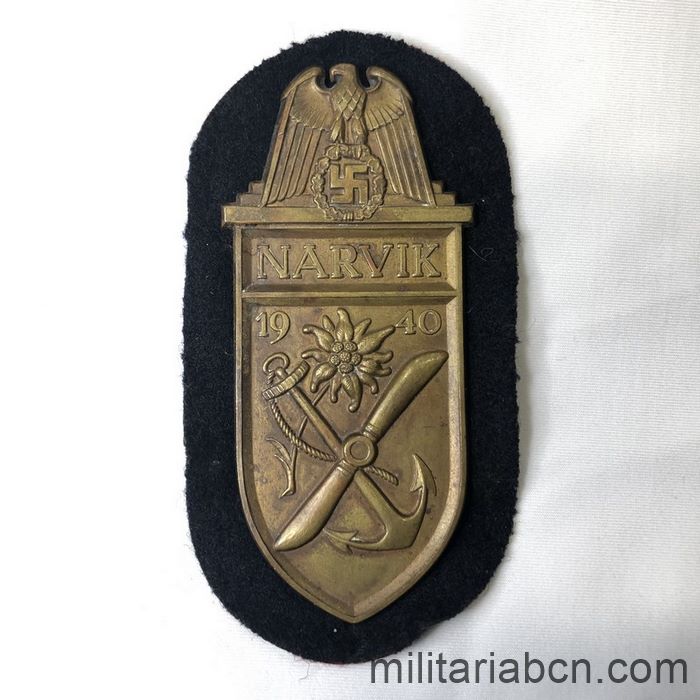
Germany III Reich. Narvik shield. Guilded, by the Kriegsmarine, With the backdrop.
Ärmelschild Narvik 1940 für Angehörige der Kriegsmarine.
The Narvik Shield (Narvikschild in German) was a German military decoration instituted during World War II by the Wehrmacht. It was established on August 19, 1940, to commemorate the participation of German troops in the Battle of Narvik, which took place between April and June 1940 in northern Norway during the Norwegian campaign.
The Battle of Narvik was one of the first combined operations of the war, involving intense combat between German and Allied forces (mainly Norwegian, British, French, and Polish). Despite tactical setbacks, the Germans managed to secure Narvik, a strategic port used for transporting Swedish iron ore, which was vital to the German war industry.
The Narvik Shield was the first of several «campaign shields» awarded by the Third Reich to commemorate specific battles.
The shield has an elongated plaque shape, with the Nazi national eagle holding a swastika at the top, the word “Narvik” beneath it followed by the year “1940.” Below the eagle, a propeller (symbol of the Luftwaffe) and an anchor (Kriegsmarine) cross over an edelweiss (symbol of the mountain troops of the Heer), representing the cooperation between the three branches of the German military: land, sea, and air.
German decoration from the Second World War.