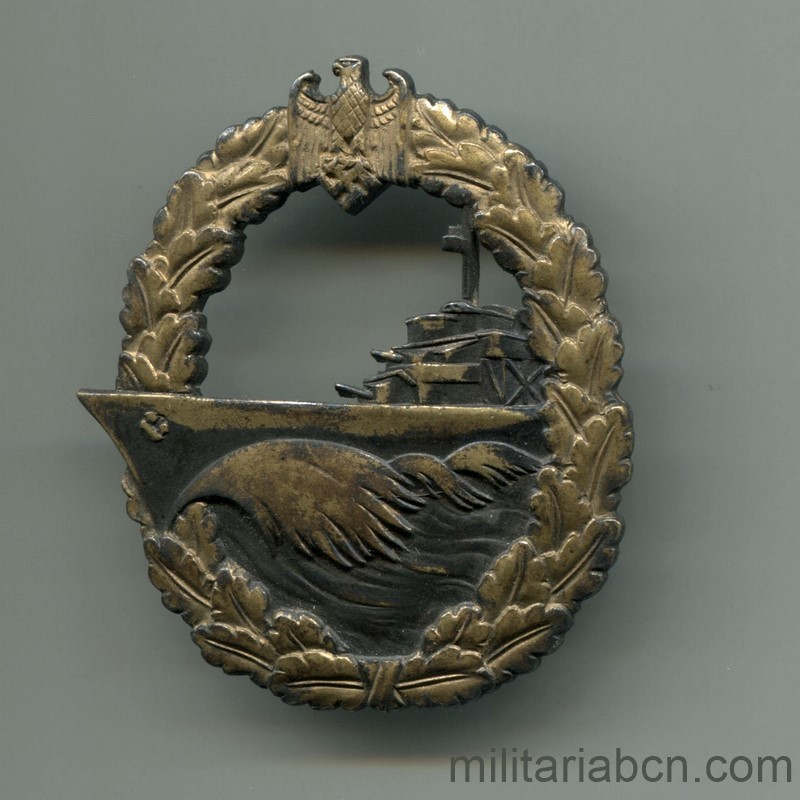
Germany. Third Reich. Second World War. War Merit Medal (Kriegsverdienstmedaille). 1940
The War Merit Medal (Kriegsverdienstmedaille, KVM) was an official German decoration instituted on 19 August 1940 during the Second World War to recognize services rendered to the war effort, particularly by civilian personnel not directly involved in combat operations.
The medal was primarily awarded to industrial workers, agricultural workers, transport and infrastructure personnel, and others employed in sectors essential to the German wartime economy. Its introduction provided recognition for contributions made behind the front lines, distinct from military achievements and higher levels of service rewarded by the War Merit Cross.
The medal, with a bronze-coloured finish, features on the obverse a representation of the War Merit Cross with a central swastika, surrounded by an oak-leaf wreath. The reverse bears the inscription “FÜR KRIEGSVERDIENST 1939” (“For War Merit 1939”), accompanied by decorative oak leaves.
The decoration is suspended from a ribbon featuring black, white and red longitudinal stripes, reflecting the characteristic colour combination of German war merit decorations of this period.
The Kriegsverdienstmedaille is a historical example of the awards system established by the National Socialist regime to recognize civilian contributions to the wartime economy and war effort during the Second World War.
War Merit Medal (Kriegsverdienstmedaille), instituted in 1940, bronze-coloured finish, with regulation black, white and red ribbon. Germany, Third Reich, Second World War.