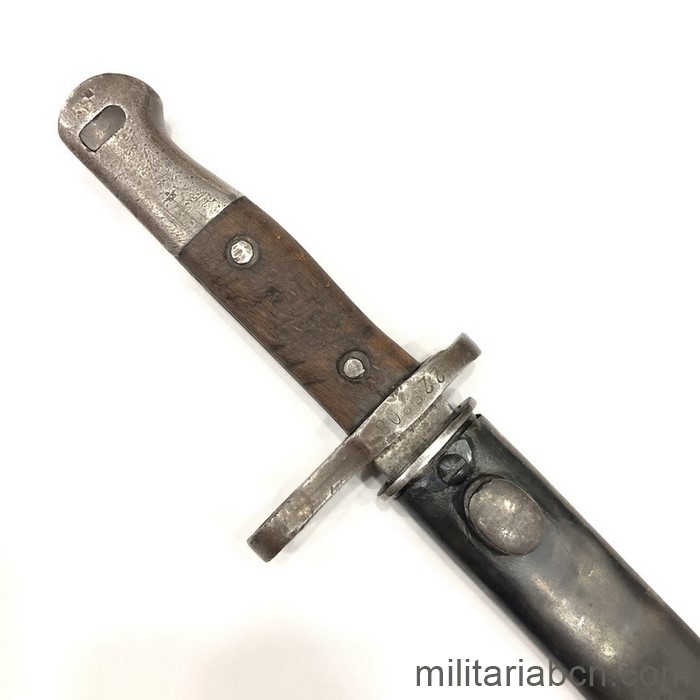
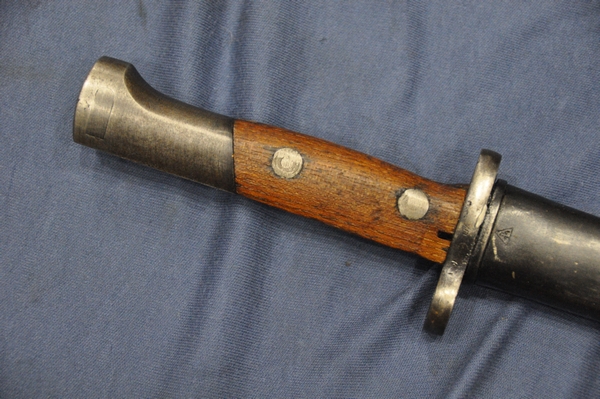
Japan. Japanese Arisaka Type 30 Bayonet by Matsushita Kinzoku
This bayonet began production in 1897 in the Empire of Japan and remained in service from the Russo-Japanese War through the Second World War. It is designated the Type 30 because it was adopted in 1897, the 30th year of the Meiji era. It was the standard bayonet of the infantry of the Imperial Japanese Army.
The blade bears the three-leaf clover emblem, representing a stack of cannonballs viewed from above, which was the mark of the Kokura Rikugun Zoheisho (Kokura Army Arsenal), together with the arrow passing through an «M,» the trademark of Matsushita Kinzoku (Matsushita Metal Co., Ltd. / 松下金属株式會社), a subsidiary of Matsushita Denki (Matsushita National Electric Co.). These markings indicate that the bayonet was manufactured by Matsushita Kinzoku under the supervision of the Kokura Arsenal, which oversaw the production of bayonets between 1938 and 1944.
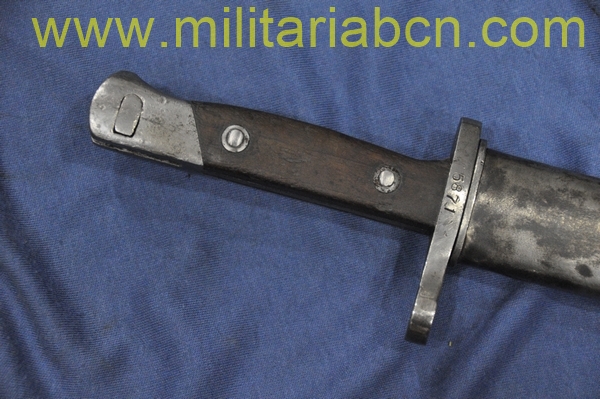
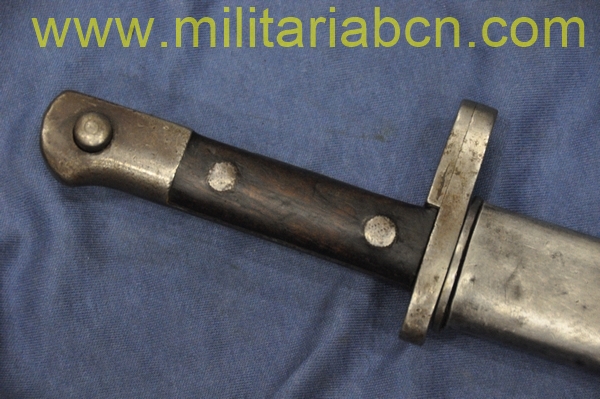
The blade features the characteristic katana-style profile. The crossguard retains its original quillon hook, and the serial number is stamped on the top of the hilt.
Original Japanese Second World War bayonet.
Bayonet length: 52.4 cm
Length without scabbard: 51.1 cm
Blade length: 39.9 cm