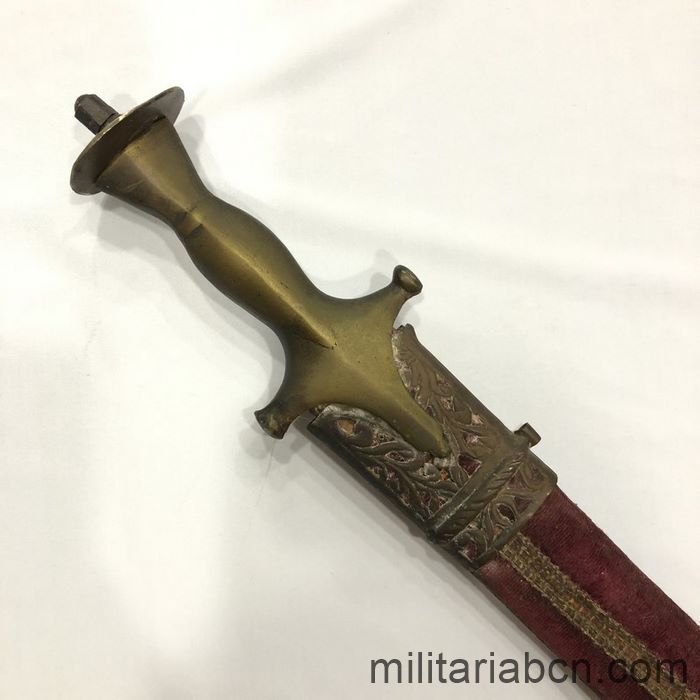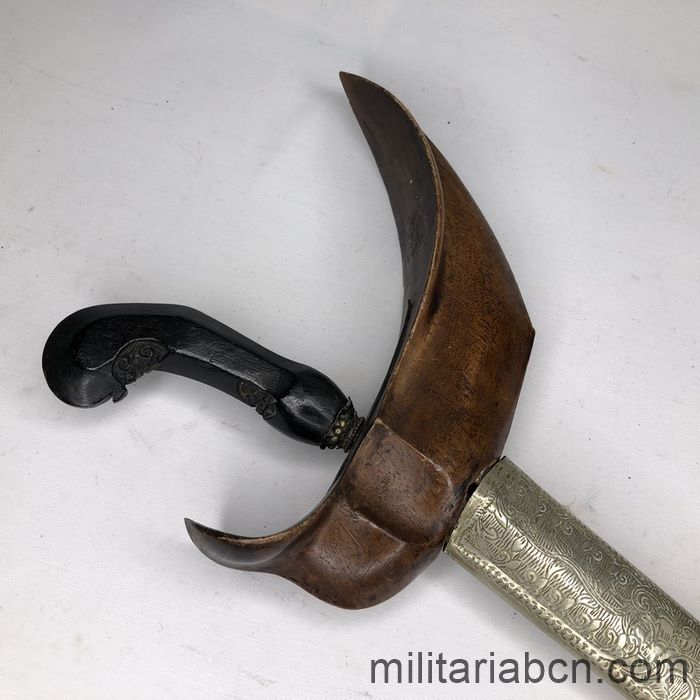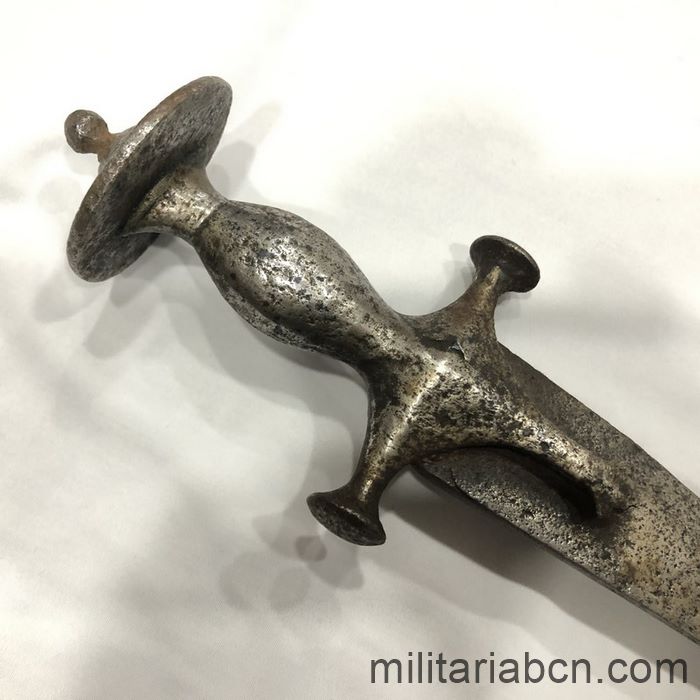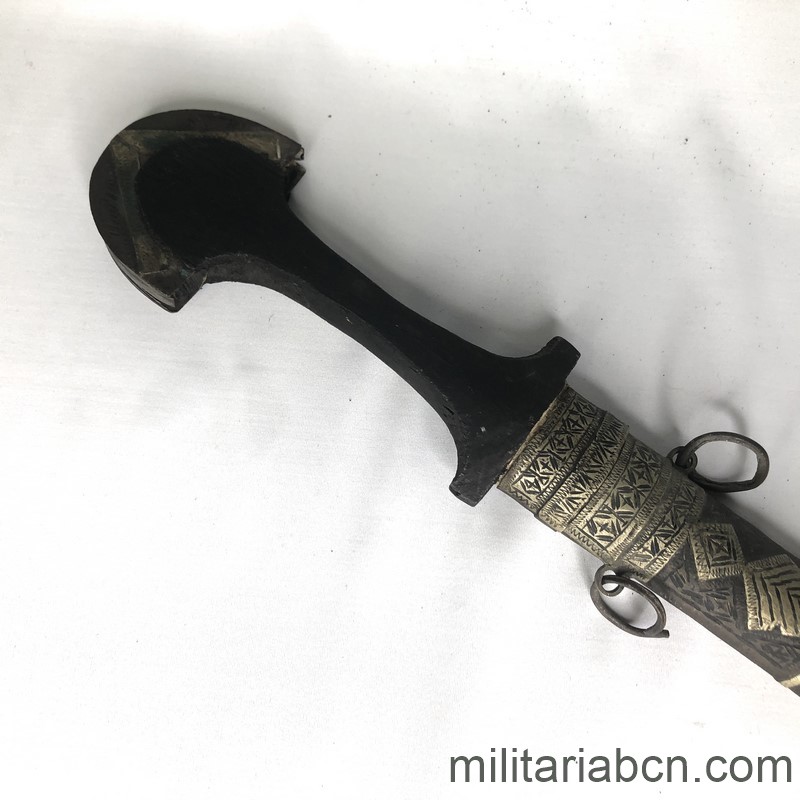




Nepal. Kukri or khukuri (Nepalese).
Used by Gurkha troops of Nepal, India, and the United Kingdom.
20th Century.
It has a slight curve of about 20°, although some have a much more pronounced angle. It is about 3 to 10 millimetres thick. It is almost always single-edged. It usually has a thick spine of around 5 millimetres, and in many ways it is a hybrid between a knife and an axe. Some are forged from vehicle or truck leaf springs. Traditional kukris usually have a handle made of hardwood or horn. Some aluminium-forged examples are modern, non-functional models. The blade typically extends to the end of the handle. The wood and horn are bonded with an adhesive called «laja», whose exact formula is unknown, though it is known to contain plant resins, beeswax, etc. Today some kukris are produced by contractors for the modern Indian Army.
On the inner part of the blade, near the handle, it traditionally has a crescent-shaped notch called cho, kauri, or kaura. The kauri is one of the kukri’s distinctive features. Various meanings are ascribed to it, including: Shiva’s trident (the Hindu god of war and destruction), the female clitoris, a fertility symbol, the reproductive organ of various Hindu gods and goddesses, the Sun, the Moon, and a symbol of Nepal. It is also said that the fact the edge does not end in a guard (a piece that protects the hand from cuts) allows for a perfect edge, somewhat like the Spanish V, which is how edges end at the guard to sharpen well on a grindstone.
It is also claimed to prevent blood flow from the blade wetting the handle during combat. Perhaps the most plausible explanation is that it is a notch made for religious purposes rather than a defensive feature of the knife, since although some sources claim this notch can catch an opponent’s weapon and be used to disarm them, there is no evidence and experts have called this unlikely. It includes the two small knives and the leather frog/tassel.
Total length 465 mm.
Blade length 288 mm.