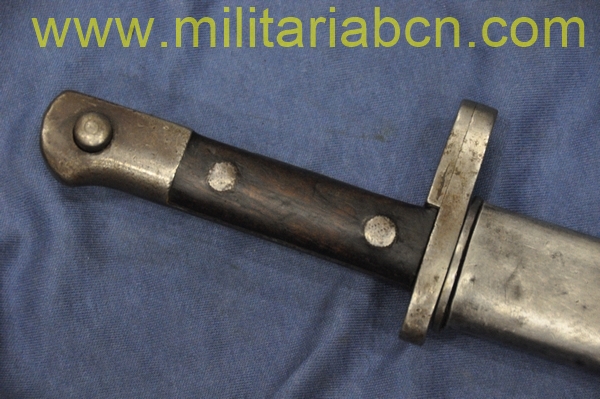
United Kingdom. No. 5 Mk I Jungle Carbine Bayonet.
Knife bayonet for the Lee-Enfield No. 5 Mk. I .303 caliber rifle. The No. 5 Mk. I was also used with the Sterling L2 9mm submachine gun.
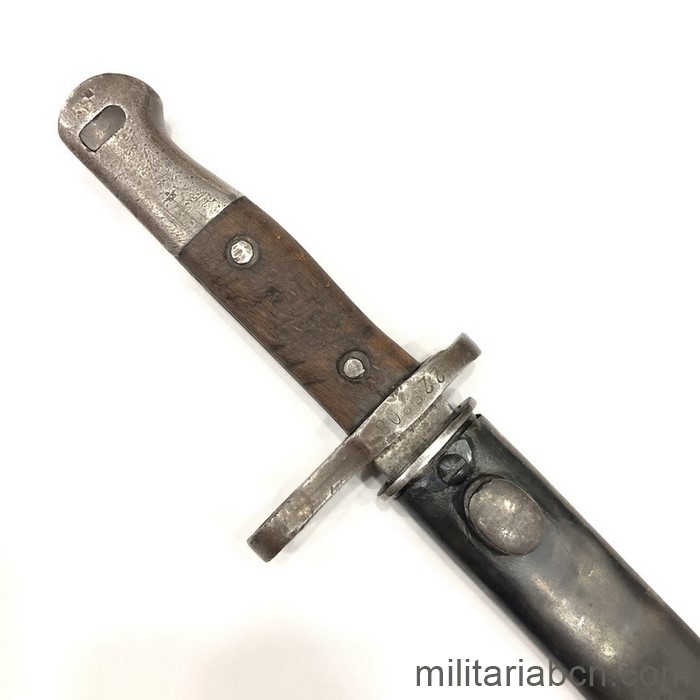
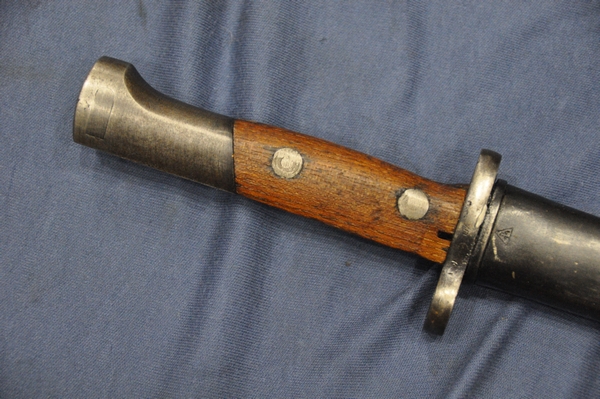
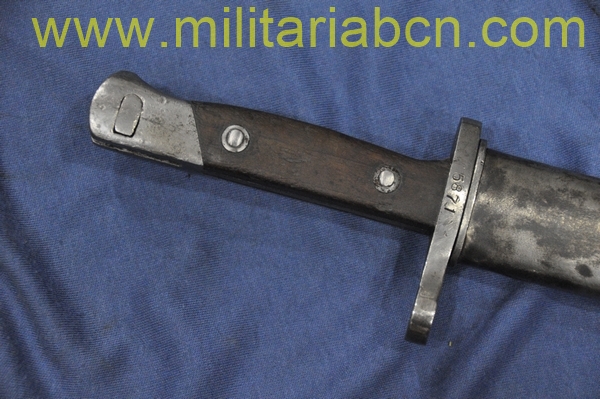
The No. 5 rifle had a shorter barrel and was lighter, specifically designed for airborne troops in the European theater during World War II. Despite its original purpose, the No. 5 carbine saw most of its service in post-war colonial conflicts, such as the Malayan Emergency, earning the nickname «Jungle Carbine.» Production of the No. 5 bayonet began in March 1944 and ended in December 1947. Initially, four companies were contracted to produce the No. 5 bayonet: Wilkinson Sword Company, London, produced 188,354; Viners Ltd., Sheffield, 42,000; Radcliffe, 75,000; and Elkington & Co. Ltd., Birmingham, 10,768. An unknown but small number were produced post-WWII at the Royal Armaments Factory in Poole, Dorset. This bayonet was produced by the Wilkinson Sword Company of London. The 203mm Bowie blade with clipped point has a single edge and a long, unique groove beneath the rounded spine. The blade features a rare blued finish and is in excellent condition, retaining its factory edge without the need for further sharpening. The ricasso is marked with the WSC factory mark. The obverse of the ricasso bears a broad arrow stamp, a bending test X, and a small crowned inspection mark. The wraparound wooden grips are in good used condition and are firmly attached with two screws. The eagle pommel and crossguard retain their original finish and are in good condition, with signs of use and age. The pressure button works perfectly. The scabbard retains its original black finish, and the bayonet slides in and out smoothly, holding firmly. This is an excellent example of a British jungle carbine bayonet, which is rare.
This example was made by Wilkinson Sword Co. Ltd., 53 Pall Mall, London. The scabbard is the early No. 5 type, without the thick brass throat found on post-war scabbards.
Unlike most bayonets, the wooden grips fully wrap around the tang.
316 122 No. 5 Mk. I bayonets were produced in late 1945. The wartime production was handled by four manufacturers:
—Wilkinson Sword Co.—188,354
—Viners Ltd.—42,000
—Radcliffe—75,000
—Elkington & Co. Ltd.—10,768
The crossguard is made by Enfield, marked DE.
The scabbard is marked with post-war markings.
No. 5 Mk. I bayonets were also produced commercially by Sterling Ltd. for sale with the Sterling (Patchett) 9mm submachine gun and at the Rifle Factory Ishapore, India. Ishapore bayonets were produced in small quantities.
With white leather scabbard.
British World War II bayonet.
Bayonet length: 31.5 cm
Length without scabbard: 29.5 cm
Blade length: 19.5 cm