




United Kingdom. Commando Knife or Fairbairn Sykes. Made by Venture H.M. Slater Sheffield.
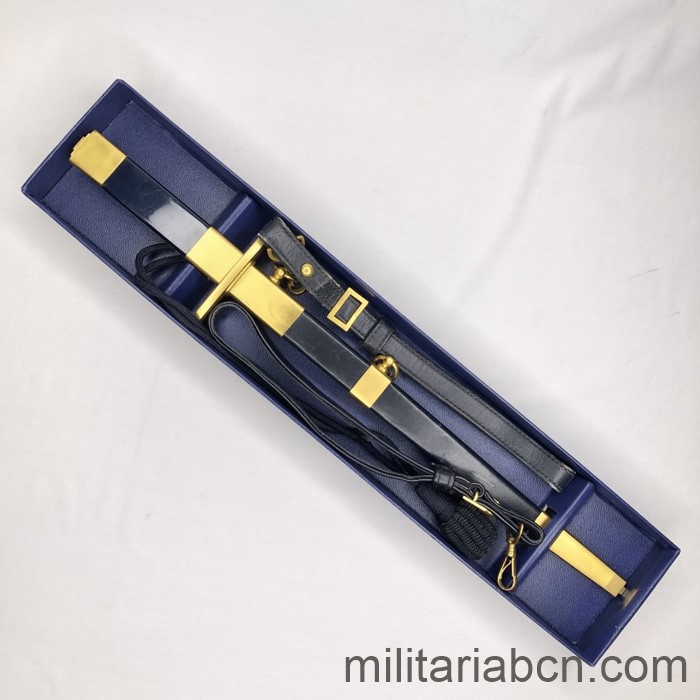
Leather imitation scabbard. Grip and tip of the scabbard in brass.
Manufactured after 1980.
Knife length with scabbard: 32 cm
Length without scabbard: 28.7 cm
Blade length: 17.6 cm
The Fairbairn-Sykes combat knife is a double-edged combat knife resembling a dagger or stiletto with a brass or wood grip. It was developed by William Ewart Fairbairn and Eric Anthony Sykes in Shanghai, based on ideas both men had while serving in the Shanghai Municipal Police in China before World War II.
The FS combat knife became famous during World War II when it was issued to British commandos, airborne forces, the SAS, and many other units, especially for the D-Day landings in June 1944. With its sharp, pointed blade, it was often used as a combat knife for thrusting, although the FS knife can also be used for cutting an opponent when its cutting edges are sharpened to specification. The Wilkinson Sword Company manufactured the knife with slight design variations to the pommel and grip.
The FS knife is strongly associated with British commandos, the U.S. Office of Strategic Services (OSS), and Marine Raiders (who based their knife on the Fairbairn-Sykes), among other special forces. It appears on the insignia of the 3rd British Commando Brigade, the Belgian Commandos, the Dutch Commando Corps (formed in the UK during WWII), and the 1st and 2nd Australian Commando Regiments and U.S. Army Rangers (all formed after the war). A large number of Fairbairn Sykes knives of various types, including some with wood grips, were used by the 3rd Canadian Infantry Division that landed on Juno Beach on D-Day and by the men of the 1st Canadian Parachute Battalion. A solid gold FS combat knife is part of the commandos’ memorial at Westminster Abbey.
The first batch of 50 FS combat knives was produced in January 1941 by Wilkinson Sword Ltd. Fairbairn and Sykes had traveled to their factory from the Special Training Centre at Lochailort in November 1940 to discuss their ideas for a combat knife. In November 1940, an order for 1,500 knives of this first pattern was placed. In 1941, an order was made for 38,000 of the second pattern (slightly revised to meet wartime demands). When the third pattern of design refinements (dating from October 1943) was introduced, the knife was already being produced by several manufacturers. There was no formal specification until after the war, but the UK government specification E/1323E from 1949 remains in effect.
In December 2019, a SBS commando in Afghanistan used an FS knife during an ambush by ISIL Da’esh fighters.